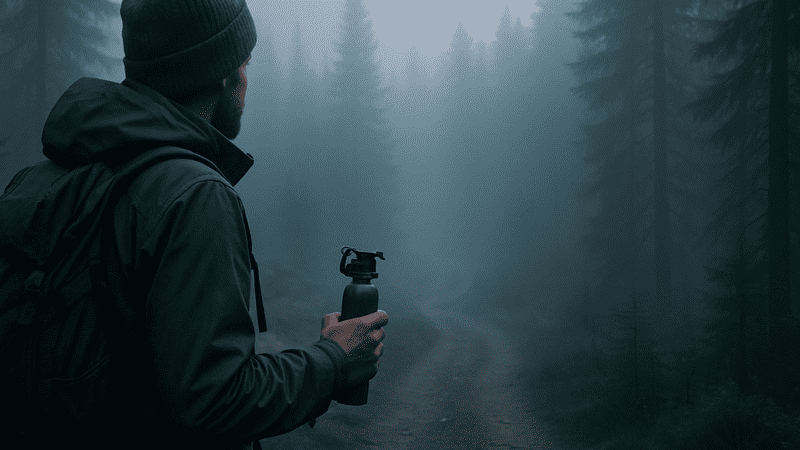
Most bear spray canisters claim a range of 25 to 35 feet, but the number on the label almost never matches what happens in real conditions — wind, panic, and reaction time all eat into that distance fast. The real usable range most people get in a genuine encounter is closer to 12 to 20 feet, and almost nobody knows that until it’s too late to matter. Understanding the gap between advertised range and functional range is the difference between a spray that works and one that becomes a very expensive prop.
What is the real range of bear spray?
Here’s what the label doesn’t tell you. That “25 to 35 foot range” printed on the can is measured in ideal, wind-free, laboratory-style conditions — someone standing still, spraying in a straight line, with zero adrenaline and zero wind. That’s not the woods. That’s not a startled hiker with a spike of cortisol hitting their bloodstream and hands that suddenly won’t stop shaking.
In the field, the effective range drops. Wind alone can cut your usable distance by a third or more, and that’s before you factor in the half-second delay most people experience just locating the safety clip under pressure. The real number — the one that should actually inform how you carry and when you deploy — sits closer to 12 to 20 feet for most commercially available canisters.
Why does this matter so much? Because the gap between the label and the reality is exactly where bad outcomes live. Someone who thinks they have 30 feet of buffer behaves differently than someone who knows they’ve really only got 15. That gap is the part of this story most retailers never explain, and it’s the part that actually keeps people safe.
Why does wind change bear spray range so much?
Wind doesn’t just reduce range — it can redirect the entire cone of spray back toward you. This is the detail almost nobody mentions until they’ve already learned it the hard way. A crosswind of even 10 mph can pull a fogger-style spray pattern sideways by several feet, turning what should be a straight-line deterrent into something closer to a coin flip.
There’s a reason experienced hikers pay attention to wind direction before they ever pull the trigger — not just for accuracy, but for self-preservation. Spraying directly into the wind is one of the fastest ways to incapacitate yourself instead of the animal or attacker in front of you. That’s not a footnote. That’s the single most overlooked variable in the entire bear spray conversation.
This is exactly why formula and delivery method matter as much as range. A heavier stream-style spray cuts through wind better than a fogger, at the cost of a slightly narrower coverage area. Most people never learn this trade-off exists until they’re standing in a sporting goods aisle guessing. If you’re stocking up for backcountry trips, it’s worth reviewing the options built specifically for hiking and camping rather than grabbing whatever’s closest to the register.
How far away should the threat be before I spray?
The honest answer is closer than most people are comfortable with — and that discomfort is exactly why so many sprays get used too late. Given the real-world range numbers above, the window where spray is genuinely effective is smaller and closer than the marketing suggests. Waiting until a threat is at the edge of the labeled range often means you’re already past the point where the spray can do its job before contact happens.
This isn’t about being reckless. It’s about recalibrating expectations before the moment arrives, not during it. The hikers and campers who fare best in bear encounters aren’t the ones who bought the biggest canister — they’re the ones who understood, ahead of time, exactly how close is “close enough” to act.
The same logic applies off the trail. Someone carrying pepper spray in the car for a parking lot encounter is working with an even tighter margin — indoor and semi-enclosed spaces compress that already-short effective range even further. What works in open woods behaves differently in a stairwell or a garage, and that’s a detail worth sitting with before you ever need it.
Does canister size affect spray range or just duration?
Size affects both — but not in the way most people assume. A larger canister generally holds more total spray volume, which extends how many bursts you get and how long each burst lasts, but it doesn’t automatically mean a longer initial range. Range is driven far more by nozzle design, pressure, and formula viscosity than by how much liquid sits inside the can.
This is where things get interesting. Some of the most compact options — like a discreet, easy-grip canister designed for elderly users — are engineered with wider dispersal patterns specifically to compensate for weaker grip strength or slower reaction times, sometimes outperforming bulkier canisters in actual usable range. Bigger isn’t always better. It’s just bigger.
What actually separates a reliable canister from a disappointing one is something almost nobody checks before buying: spray pattern consistency across the full duration of the can, not just the first burst. A canister that sprays strong for three seconds and weak for the next six isn’t giving you the range it claims — it’s giving you a shrinking window disguised as a full one.
What’s the difference between bear spray range and pepper spray range for personal defense?
Bear deterrent sprays and personal defense pepper sprays are built for different problems, and conflating the two is where a lot of buyers go wrong. Bear spray is formulated for a large, fast-moving animal at a distance, with a wide fogging pattern meant to create an air barrier. Personal defense spray for human threats is often formulated for closer, more precise application — which changes what “range” even means.
Someone working a shift and carrying pepper spray built for security guard use needs a different range profile than a hiker in open terrain. Precision streams designed for professional use are built to reach 10 to 15 feet with tight accuracy — useful in crowd or hallway situations where a wide fog would affect bystanders. That’s a completely different design philosophy than a bear deterrent, even though both products get lumped into the same conversation.
This distinction rarely gets explained clearly, and it’s part of why so many people end up with the wrong tool for their actual situation. If you’re deciding between something for the trail versus something for defending your home, the range numbers you should care about are not the same numbers.
How do I test my bear spray’s actual range before I need it?
You don’t test with the can you plan to carry — that’s the mistake almost everyone makes. Every canister has an expiration date, and once you discharge it even briefly for practice, you’ve started the clock on a product you may need at full pressure later. The smart move is buying an inert practice canister specifically for training, then keeping your live canister sealed and ready.
Practice on a calm day with no wind, then again on a breezy one, so you can feel — not just read about — how much distance and accuracy you lose. Most people who skip this step discover the difference at the worst possible moment. The ones who don’t skip it walk into a real encounter already knowing their equipment’s actual limits, not the number printed on the label.
It’s also worth reviewing how to use pepper spray correctly, since deployment technique changes your effective range almost as much as the canister itself does. Grip, stance, and trigger discipline all factor into whether that 15-foot window actually gets used, or wasted.
Frequently Asked Questions About Bear Spray Range and Coverage
How far does bear spray actually reach?
Labels typically claim 25 to 35 feet, but real-world usable range — accounting for wind, reaction time, and adrenaline — is closer to 12 to 20 feet for most canisters. That gap between advertised and actual range is the single most important thing to understand before carrying one into the backcountry.
Does wind really make that much difference to bear spray range?
Yes — a crosswind as light as 10 mph can shift the spray pattern several feet off course, and spraying directly into headwind can blow the deterrent back toward you. Checking wind direction before deploying isn’t optional caution, it’s a core part of using the product correctly.
Is a bigger bear spray canister automatically better range?
Not necessarily. Canister size mainly affects total spray duration and number of bursts, not initial range. Range depends more on nozzle design, internal pressure, and formula thickness — some compact canisters actually outperform larger ones in dispersal distance.
Can I use regular pepper spray instead of bear spray on the trail?
They’re formulated differently. Bear spray uses a wider fogging pattern designed for large animals at distance, while personal defense pepper spray is often built for closer, more targeted use against human threats. Using the wrong type can leave you with less effective range than the situation demands.
How close should a bear or attacker be before I spray?
Given real-world range limitations, most effective deployment happens inside 15 to 20 feet, not at the maximum labeled distance. Waiting until a threat reaches the edge of the “advertised” range often means acting too late for the spray to fully do its job.
Does bear spray expire, and does that affect range?
Yes. Expired canisters lose pressure over time, which directly reduces both range and spray duration — sometimes dramatically. Checking the expiration date every season, not just at purchase, is a habit worth building into your gear routine.
Should I practice-spray my bear spray to test the range?
Not with your primary canister. Use a separate inert practice canister so your actual carry spray stays fully pressurized and sealed until you genuinely need it. Testing on both calm and windy days gives you a realistic sense of your true effective range.
Is bear spray legal to carry everywhere?
Regulations vary by state and by land — some parks and public lands have specific rules. It’s worth reviewing pepper spray laws by state before you travel with any canister, since restrictions can differ from general pepper spray regulations.
The Number That Matters More Than the One on the Label
There’s a reason this information doesn’t show up on packaging. The label number sells the can. The real number — the 12 to 20 feet that actually plays out in the field — is the one that keeps you alive, and it’s the one almost nobody bothers to explain before you’re already holding the canister with your thumb on the clip.
Knowing the gap between the two isn’t a small detail. It’s the entire difference between a false sense of security and genuine preparedness. Take the time to understand your specific canister’s real-world behavior — wind, distance, duration — before you’re standing on a trail with a decision to make in half a second. Stay safe out there.