For most adults, a telescopic baton between 16 and 21 inches extended is the right length for personal self-defense. Shorter models — around 16 inches — are easier to carry and deploy in tight spaces, while 21-inch batons give you more reach and striking power. Your height, grip strength, where you’ll carry it, and your local laws all factor into the right choice. There is no single universal answer, but there is a right answer for you — and picking wrong has real consequences.
Here’s the thing — most people shopping for a telescopic baton spend all their time looking at features and forget to ask the most basic question first: will I actually be able to use this thing when it counts? Length isn’t just a number. It determines whether you can control the baton, whether you can deploy it fast enough, and whether it gives you any real advantage in a bad situation. I’ve been in this business for over 25 years and I’ll tell you right now — the wrong size baton is worse than no baton at all, because it gives you false confidence and fails you when the pressure’s on.
What sizes do telescopic batons come in, and which is most common for self-defense?
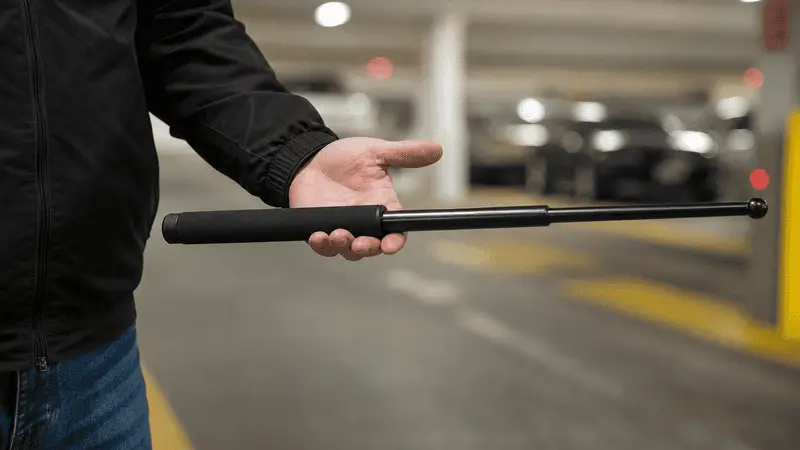
Telescopic batons — also called expandable batons or collapsible batons — typically come in three main size categories when fully extended: 16 inch, 21 inch, and 26 inch. Each collapses down to roughly one-third of that extended length for carry. A 21-inch baton, for example, collapses to about 8 inches — small enough to fit in a jacket pocket, large cargo pocket, or a belt holster.
The 21-inch model is by far the most commonly recommended size for civilian self-defense. It provides enough reach to keep a threat at a meaningful distance — roughly arm’s length plus — while remaining manageable for someone without extensive training. The 16-inch is better for smaller individuals, people who carry in tight spaces, or anyone who values concealment over reach. The 26-inch is longer than most civilians need and becomes harder to control without dedicated training.
Now look, the collapsed length matters just as much as the extended length. If you can’t carry the baton on your person consistently, it won’t be there when you need it. A baton sitting in your glove box or at the bottom of a bag is not a self-defense tool — it’s just a piece of metal doing nothing for you.
How does your height and arm length affect the right baton size for you?
This is one detail most people skip, and it’s a mistake. Body mechanics matter in a self-defense situation. A person who is 5’2″ swinging a 26-inch baton is fighting the tool as much as the threat. It throws off your balance, it’s harder to generate controlled force, and if the attacker gets inside your swing radius, that long baton becomes useless in a heartbeat.
A general guideline: your extended baton should reach from your hip to roughly mid-chest height when held at your side — about the length of your arm from shoulder to palm. For most adults between 5’4″ and 5’10”, that puts you squarely in 21-inch territory. Taller individuals may find the 26-inch more natural. Shorter individuals, or those with smaller hands and less grip strength, will likely have better control with a 16-inch model.
Grip strength is also a legitimate factor. A heavier, longer baton requires more force to swing with precision. If you’re not hitting the gym regularly and don’t plan to train with the baton, go shorter. A shorter baton you can control beats a longer one you can’t. I’m gonna tell you right now — controlled, accurate strikes matter more than raw reach.
Does the environment where you carry change the ideal telescopic baton length?
Absolutely — and this is where a lot of buyers don’t think it through. If you’re using a telescopic baton primarily outdoors — parking lots, jogging trails, open areas — a 21-inch model gives you excellent reach and room to maneuver. But if your concern is close-quarters situations — a hallway, an elevator, a stairwell, a car — a longer baton can actually work against you.
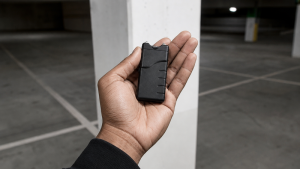
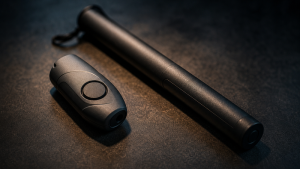
In a confined space, you lose the ability to generate a full swing. That reach advantage disappears the moment walls and furniture box you in. In those situations, a 16-inch baton, or even a combination tool like a stun gun baton with a built-in flashlight, may give you more practical options. Those combo tools let you use electrical shock capability at close range when swinging isn’t an option — and the flashlight is a real-world benefit when you’re navigating dark spaces like parking garages or poorly lit stairwells.
Think through where you actually spend time and what scenarios you’re actually preparing for. Don’t buy a baton for the scenario you saw in a movie. Buy it for the parking lot you walk through twice a week after your evening shift.
What weight and material should you look for in a self-defense baton alongside length?
Length without the right material behind it is a problem. Most quality telescopic batons are made from steel — carbon steel or aircraft-grade aluminum alloys. Steel holds up under impact and maintains its shape. A baton that bends or buckles when you need it most is not a baton — it’s a liability.
Weight factors in at both ends of the baton. The tip should be weighted — that’s where your striking force concentrates. The handle should be grippy and manageable, especially under stress when your hands may be sweating. Some models have rubber or textured grips; these are worth prioritizing over smooth metal handles for anyone who doesn’t train regularly with the tool.
For buyers who want the structural benefit of a baton combined with additional capability, it’s worth looking at our full selection of telescopic batons for self-defense — you’ll find options that combine solid construction with practical features. If you’re specifically considering a unit that does double duty, the rechargeable stun gun flashlight baton is one that I’d point you toward — it holds up structurally and gives you a secondary option that doesn’t depend on a swing.
Are there legal restrictions on telescopic baton length you need to know before buying?
This is where I have to be straight with you, and this is non-negotiable information. Telescopic and expandable batons are regulated differently depending on where you live. Some states restrict them entirely. Some cities have their own ordinances on top of state law. Length alone doesn’t determine legality — the type of baton, how it’s carried, and where you are all factor in.
I’m not going to give you legal advice — that’s not my lane. What I’m going to tell you is this: before you buy any baton, check the laws in your specific state and city. Don’t rely on what a friend told you. Don’t assume that because you saw it sold online it’s legal everywhere. Look it up. Call your local non-emergency police line if you need to. The last thing you want is a self-defense tool that turns into a legal problem before you ever need to use it for protection.
Our blog post on 5 things you must check before buying a self-defense baton covers legality alongside the other critical factors — I’d read that before you finalize any purchase decision.
How do you actually deploy a telescopic baton fast enough in a real situation?
Owning the right length baton is step one. Knowing how to open it under pressure is step two — and most people skip straight to buying without ever thinking about step two.
Telescopic batons deploy by a sharp downward flick of the wrist. The centrifugal force pushes each section out and locks it. This sounds simple in a living room. Under adrenaline, with your heart rate spiked and your hands shaking, it is less simple. You need to practice that motion until it is automatic. Ten or fifteen reps a week is enough to build the muscle memory. You’re not training for a tournament — you’re training for a situation you hope never happens.
Also consider where you carry it. A belt holster puts it in the same place every time, so your hand knows exactly where to reach. A baton buried in a bag requires you to open the bag, locate the baton, pull it out, then deploy it. In a real situation, that’s too many steps. Carry it where you can reach it with one deliberate motion.
This same principle applies to every self-defense tool. A stun gun flashlight baton that you’ve never held before under stress is not giving you any real advantage. Practice with whatever you carry.
Frequently Asked Questions About Telescopic Baton Length for Self-Defense
What is the best telescopic baton length for a woman?
For most women, a 16-inch or 21-inch telescopic baton is the right range. Smaller hands and lighter frame often make longer batons harder to control under pressure. A 16-inch model prioritizes concealment and maneuverability; a 21-inch gives more reach. The best choice depends on your height, grip strength, and where you plan to carry it — but control always wins over extra length.
Is a 21-inch baton too long to carry every day?
Not if you carry it in a belt holster or a purpose-built pocket. A 21-inch baton collapses to roughly 8 inches — small enough to clip to a belt or fit in a cargo pocket. Daily carry is realistic if the holster is comfortable and accessible. If the baton stays in your bag or car because it’s inconvenient, it’s the wrong carry method, not necessarily the wrong size.
How do I know if a telescopic baton is legal in my state?
Baton laws vary significantly by state and city. Some jurisdictions prohibit expandable batons entirely; others allow them for personal carry with no permit. You need to check your specific state statutes and local ordinances before purchasing. Do not rely on the fact that a product is sold online as confirmation it’s legal in your area. When in doubt, contact your local police department’s non-emergency line for clarity.
Can a telescopic baton replace pepper spray or a stun gun for self-defense?
No — and it shouldn’t try to. A telescopic baton is a contact-range tool that requires physical deployment and some level of physical confrontation. Pepper spray works at a distance. A stun gun works at close range without requiring a swing. For most civilians, layering tools is smarter than relying on any single one. A baton is a strong option, but it’s not a replacement for a full personal safety plan.
Does a heavier baton hit harder, or does length matter more for striking power?
Both factors contribute, but tip weight and swing speed determine impact more than raw length alone. A weighted-tip baton at 21 inches, swung with controlled speed, delivers significant force. Going up to 26 inches doesn’t automatically hit harder if you can’t generate the same swing speed or control the arc. A shorter baton you can swing accurately and quickly is more effective than a longer one you can’t handle well under pressure.
Should I get a baton with a rubber grip or a metal grip?
Rubber or textured grips are strongly preferable for anyone who isn’t an experienced practitioner. Under stress, hands sweat. A smooth metal handle in a sweating hand is a grip problem at the worst possible moment. Rubber grips maintain contact and give you positive control through the full swing. Metal handles are fine for trained users who’ve built the grip habit — for everyone else, texture is your friend.
What’s the difference between a telescopic baton and a fixed baton for self-defense?
A telescopic baton collapses for carry and extends on deployment — the main advantage is portability and discretion. A fixed baton is rigid, always at full length, which means it’s ready immediately but harder to carry concealed. For civilian self-defense and everyday carry, the telescopic design is the practical choice. For security professionals who need immediate readiness without concealment concerns, fixed batons are worth considering.
How often should I practice deploying my telescopic baton?
A minimum of ten to fifteen repetitions per week is enough to build reliable muscle memory for deployment. You don’t need extensive martial arts training — you need the deployment motion to be automatic. Practice the flick, practice your grip after deployment, and practice where your hand goes to retrieve it from your carry position. Consistent, brief practice sessions matter more than occasional long ones.
At the end of the day, the right telescopic baton length isn’t the longest one on the shelf or the cheapest one in the catalog — it’s the one you can carry consistently, deploy reliably, and control under pressure. For most people, that’s a quality 21-inch model in a good belt holster, with a few minutes of practice every week. Don’t overthink the features before you nail down the fundamentals. Size, legality, and carry position come first. Everything else comes second.
Take a few minutes to look through what we carry at Brainstorm Security Shop — we stock options across the full range of sizes and capabilities, including combination tools for buyers who want more than one layer of protection in a single device. Whatever you choose, carry it where you can reach it and know how to use it. Stay safe out there.