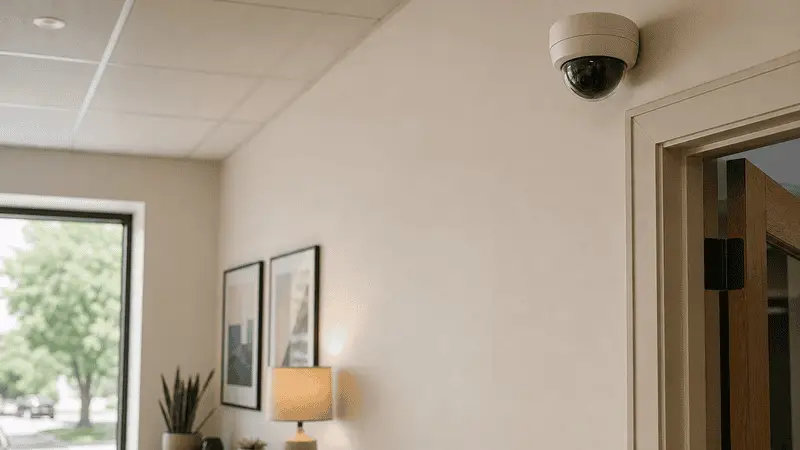
Dummy security cameras typically cost between $5 and $50, with the sweet spot for quality deterrent cameras landing in the $10 to $30 range. Basic fixed models start around $5 to $10, mid-range options with blinking LED lights and realistic housing run $15 to $25, and premium dome-style or PTZ-style fake cameras with weatherproofing and mounting hardware can reach $30 to $50 or more. For most homes and small businesses, spending $15 to $25 gets you a convincing, durable option that does the job.
Now look — I’ve been in this industry for over 25 years, and I’ll tell you straight: dummy cameras are one of the most misunderstood products in the self-defense space. People either dismiss them entirely or expect them to do something they were never designed to do. The truth is somewhere in the middle, and once you understand what you’re actually buying and what a fair price looks like, you can make a smart, confident decision. Let me walk you through it.
What factors affect how much a dummy security camera costs?
The price of a dummy camera isn’t random. A few specific factors drive the cost up or down, and knowing them helps you spend your money in the right place.
Housing quality and realism. A cheap $5 dummy camera is going to look cheap. Thin plastic, lightweight feel, seams that don’t line up — someone who knows cameras will spot it fast. A well-made dummy camera uses heavier ABS plastic or metal housing that mimics the weight and finish of a real unit. That extra material costs more to produce, and it shows in the price.
Blinking LED indicator lights. This is one of the most important features in a dummy camera. Real security cameras — especially in commercial settings — often have small indicator lights. A dummy camera with a blinking red or amber LED looks significantly more convincing than one without. Battery-powered blink features add a few dollars to the cost but are almost always worth it.
Style of camera body. Basic bullet-style cameras are the least expensive. Dome cameras — the kind you see on store ceilings — run a bit more because the housing is more complex to manufacture. PTZ-style (pan-tilt-zoom) dummy cameras that look like they can rotate cost the most because the realistic mechanical appearance requires more design work.
Weatherproofing and outdoor rating. If you’re mounting a dummy camera outside, you need a model rated for outdoor use. Weatherproof housing with sealed components costs more than an indoor model. Expect to spend at least $20 to $35 for a properly weatherproofed outdoor fake camera.
Included hardware. Some packages include a mounting bracket, screws, and even a short length of dummy cable to make the installation look authentic. That kind of attention to detail matters — a camera mounted without a cable looks suspicious to anyone paying attention. Kits with full mounting hardware cost a few dollars more, and they’re worth it.
Is a $10 dummy camera good enough, or do you need to spend more?
Here’s the thing — it depends entirely on where you’re placing it and who you’re trying to deter. A $10 model placed at the end of a long driveway, mounted high where nobody’s going to examine it closely? That’s probably fine. The distance does the work. Nobody’s walking up to inspect it.
Inside a store, a rental property common area, or a parking garage where people are going to be within arm’s reach? You want something more convincing. At that range, a person can see whether the housing is solid, whether there’s a real cable, whether the mounting looks intentional. Spend the extra $10 to $15 and get a model that holds up to closer inspection.
I always tell people: the goal of a dummy camera is deterrence. You want a potential bad actor to look at it and think “I’m being watched.” A convincing camera does that. A flimsy, obviously fake camera might actually signal that the location has cut corners — and that’s the opposite of what you want.
For a home setup, take a look at our cheap home security fake camera options — we carry models that look realistic without putting a dent in your wallet. And if you’re setting something up for a kid’s dorm room, we’ve got a dedicated page for dummy cameras for college student dorms that covers the specific considerations for that environment.
How do dummy camera prices compare for home use versus business use?
For home use, you’re usually looking at one to four cameras, and you’re focused on a few key entry points — front door, back door, garage, driveway. In that context, spending $15 to $25 per camera is completely reasonable. You don’t need a massive system. You need a few well-placed, convincing units.
For business use, the calculus changes a little. You may need more cameras to cover a larger space, which means total cost adds up. But you also need cameras that can stand up to customer scrutiny — people walking through your store are going to notice whether your cameras look real or not. For a retail or commercial setting, I’d budget $20 to $35 per unit minimum and prioritize dome-style cameras that match what real commercial systems use.
We put together a dedicated resource specifically for dummy cameras for businesses that goes deeper into commercial placement and what features matter most in a retail or office environment.
One more thing worth knowing for business owners: dummy cameras work best as part of a layered approach. Real cameras at entry and exit points, dummy cameras filling in the coverage gaps. That layered strategy gives you the coverage and the deterrence together.
Do dummy cameras require ongoing costs after you buy them?
This is one of the clearest advantages of dummy cameras over real security systems — there are almost no ongoing costs. No monthly monitoring fees. No cloud storage subscription. No professional installation charge. No wiring costs.
The only recurring cost on most dummy cameras is a single AA or AAA battery that powers the blinking LED. We’re talking maybe a dollar or two per year per camera, depending on how often the light cycles. Some models are solar-powered for outdoor placement, which eliminates even that small ongoing cost.
Compare that to a real monitored security system, which can run $30 to $60 per month or more in subscription fees. For a rental property owner, a small business on a tight budget, or a homeowner who wants basic deterrence without a long-term financial commitment, the math on dummy cameras makes a lot of sense.
Where you place a dummy camera matters as much as what you spend on it
I’m gonna tell you right now — you can buy the most convincing $40 dummy camera on the market, and if you place it wrong, it’s not going to do much for you. Placement is every bit as important as the camera itself.
Height matters. Real security cameras are typically mounted 8 to 10 feet up — high enough to capture a wide field of view, low enough to capture useful detail. If your dummy camera is mounted at eye level or way too high on a roofline, it doesn’t look right.
Visibility matters. The whole point of a dummy camera is deterrence, which means it needs to be seen. Don’t tuck it behind a bush or in a corner where nobody can see it. Put it somewhere obvious — above a doorway, at the entrance to a parking area, covering a main walkway.
Wiring matters. A camera with no cable leading to anything looks incomplete. Run a short length of conduit or cable from the camera to the wall, even if it doesn’t connect to anything. That detail makes a difference.
We’ve got a full blog post on the best places to put a dummy camera that breaks down placement by property type — worth reading before you buy and definitely before you install.
Are dummy cameras a good value compared to real security cameras?
They serve different purposes, so the comparison isn’t quite apples-to-apples. A real security camera gives you actual recorded footage. That’s valuable for insurance claims, police reports, identifying a suspect after the fact. A dummy camera gives you deterrence — the possibility of being watched, which may prevent an incident from happening in the first place.
Here’s my honest take: if you can only afford one approach, a real camera is the better tool. But most people aren’t choosing between one real camera and one fake one. They’re deciding how to cover a lot of space on a limited budget. In that situation, combining a couple of real cameras with several well-placed dummy cameras gives you the best of both — documented coverage at the most critical points, and visible deterrence everywhere else.
For the money, dummy cameras offer one of the best cost-per-deterrence ratios in the security world. Spending $60 to $100 on four well-placed dummy cameras can cover a perimeter that would cost $500 to $1,000 in real camera hardware and installation.
Frequently Asked Questions About Dummy Security Camera Costs
How much does the average dummy security camera cost?
Most dummy security cameras sell for between $10 and $30. Basic indoor models start around $5 to $10, while more realistic outdoor-rated models with blinking LEDs, weatherproof housing, and full mounting hardware typically run $20 to $40. You can find convincing, durable options in the $15 to $25 range for most home and small business applications.
Are cheap dummy cameras worth buying?
It depends on where you’re placing them. A budget $8 to $10 model can work well when mounted high or at a distance where close inspection isn’t likely. For locations where people will pass within a few feet — like inside a store or near a front door — a cheap camera may look obviously fake and undermine your credibility. Spending $18 to $25 buys you noticeably better realism in those situations.
Do dummy cameras have any ongoing monthly costs?
No. This is one of the biggest advantages of dummy cameras over real security systems. There are no monitoring fees, no cloud storage subscriptions, and no installation costs. The only ongoing expense is the small battery that powers the blinking LED light — typically a single AA or AAA battery that lasts many months. Some outdoor models use solar power and eliminate even that small cost.
How many dummy cameras do I need, and how much will the total cost be?
For a typical home, two to four cameras covering entry points and perimeter corners is a reasonable setup — that puts your total investment between $40 and $120 depending on the models you choose. For a small business, four to eight cameras covering entrances, registers, and storage areas is common, with total costs ranging from $80 to $250 for a quality setup that looks convincing.
What’s the difference between a $10 dummy camera and a $40 one?
The main differences are housing quality, realism of the design, weatherproofing, and included hardware. A $10 model is typically lightweight plastic, may or may not have a blinking LED, and is designed for basic indoor use. A $40 model usually features heavier housing, a more realistic camera lens and body design, weather resistance for outdoor mounting, and a complete mounting kit with hardware and cable for a finished look.
Can dummy cameras be used outdoors, and does that cost more?
Yes, outdoor dummy cameras are available and are specifically designed with weatherproof or weather-resistant housing to handle rain, temperature swings, and UV exposure. Outdoor models do cost a bit more — typically $20 to $40 compared to $10 to $20 for indoor models. That extra investment is worth it; an indoor-rated camera mounted outside will deteriorate quickly and start to look obviously fake as the housing fades and warps.
Should I use dummy cameras alone, or combine them with real security measures?
For the best results, dummy cameras should be part of a layered security approach rather than your only line of defense. Combine them with at least one or two real cameras at critical entry points, proper exterior lighting, strong locks, and if appropriate, other non-lethal security tools. Dummy cameras are a deterrence layer — they work best alongside real countermeasures, not instead of them.
Is it legal to use dummy security cameras?
In most jurisdictions, yes — placing a dummy camera on your own property is legal. However, laws vary, and there are situations where the placement or implied surveillance could raise legal questions, particularly in areas where people have a reasonable expectation of privacy. It’s always a good idea to research your local and state regulations. For a broader look at camera-related laws, our post on state laws for hidden spy cameras is a useful starting point — though dummy cameras and hidden cameras are separate categories with different legal considerations.
The bottom line on dummy cameras is this: they’re an honest, affordable, and genuinely effective part of a smart security setup when you know what to buy and where to put them. You don’t have to spend a fortune. You just have to spend thoughtfully. Spend $15 to $25 on a realistic model with a blinking LED, mount it where it can be seen and where it makes sense, and you’ve added a real layer of deterrence for the cost of a couple of lunches.
If you’re ready to put something in place, browse our full selection of home security dummy cameras and find an option that fits your space and your budget. And if you’re building out security for a business location, don’t skip our business dummy camera page — there’s more to consider in a commercial setting, and we’ve laid it all out. Stay safe out there, and may you and your loved ones stay protected.