Quick Answer: Before you buy any self-defense baton, you need to verify five critical things: local legality, material and build quality, expansion mechanism reliability, grip security, and size-to-power ratio. Skip any one of these and you could end up with a tool that gets you arrested, fails in a real confrontation, or costs you precious seconds when seconds are all you have.
Why Does It Matter What Baton You Buy?
Here’s the thing – a self-defense baton looks simple. It’s a stick. How complicated can it be? But I’ve been in this industry for over 25 years, and I’m gonna tell you right now, I’ve seen people walk in with batons they bought online that would have gotten them arrested just for having them in their car. I’ve seen batons that won’t expand under pressure. I’ve seen handles that become slippery the moment your palms sweat – and trust me, your palms will sweat when adrenaline kicks in.
A baton that fails at the wrong moment isn’t just a bad purchase. It’s a dangerous one. Let’s go through the five things you absolutely must check before you hand over your money. And yes – don’t skip number three. That one catches more people off guard than anything else.
What Are the Legal Rules for Carrying a Baton in Your State?
Legality is the first thing you check – full stop. In many states, expandable or collapsible batons are outright illegal for civilian carry. In others, they’re restricted to use on your own property. In some states, you can carry them openly or concealed with no issues. The problem is that most people assume that if something is for sale online, it must be legal to carry. That assumption is wrong and it can cost you dearly.
Before you buy, run through this checklist:
- Search your state’s penal or criminal code for terms like expandable baton, collapsible baton, asp baton, or billy club
- Check your city and county ordinances – local laws can be stricter than state law
- Confirm whether open carry and concealed carry rules differ for batons in your jurisdiction
- If you travel, check the laws in every state you’ll pass through
- When in doubt, contact a local attorney – it’s worth a phone call
I tell every customer the same thing: I want you protected, but I also want you to stay out of legal trouble. Carrying an illegal baton means you’re the one who ends up in handcuffs. Do your homework first.
What Material Should a Self-Defense Baton Be Made From?
The material determines whether your baton holds up in an actual strike – or fails you. Not all batons are built the same, and the difference between a quality tool and cheap junk shows up fast in a real-world scenario.
Here’s what you need to know about materials:
- Aircraft-grade aluminum: Lightweight, durable, resists corrosion. This is the sweet spot for most people – strong enough to do serious work without weighing you down.
- Steel: Heavier than aluminum, but extremely solid. Good for people who prioritize impact over portability. Be aware of the added weight when carrying all day.
- Cheap alloys or zinc composites: This is where you get into trouble. Some low-cost batons look fine but bend or snap under real force. Never trust your safety to an untested alloy.
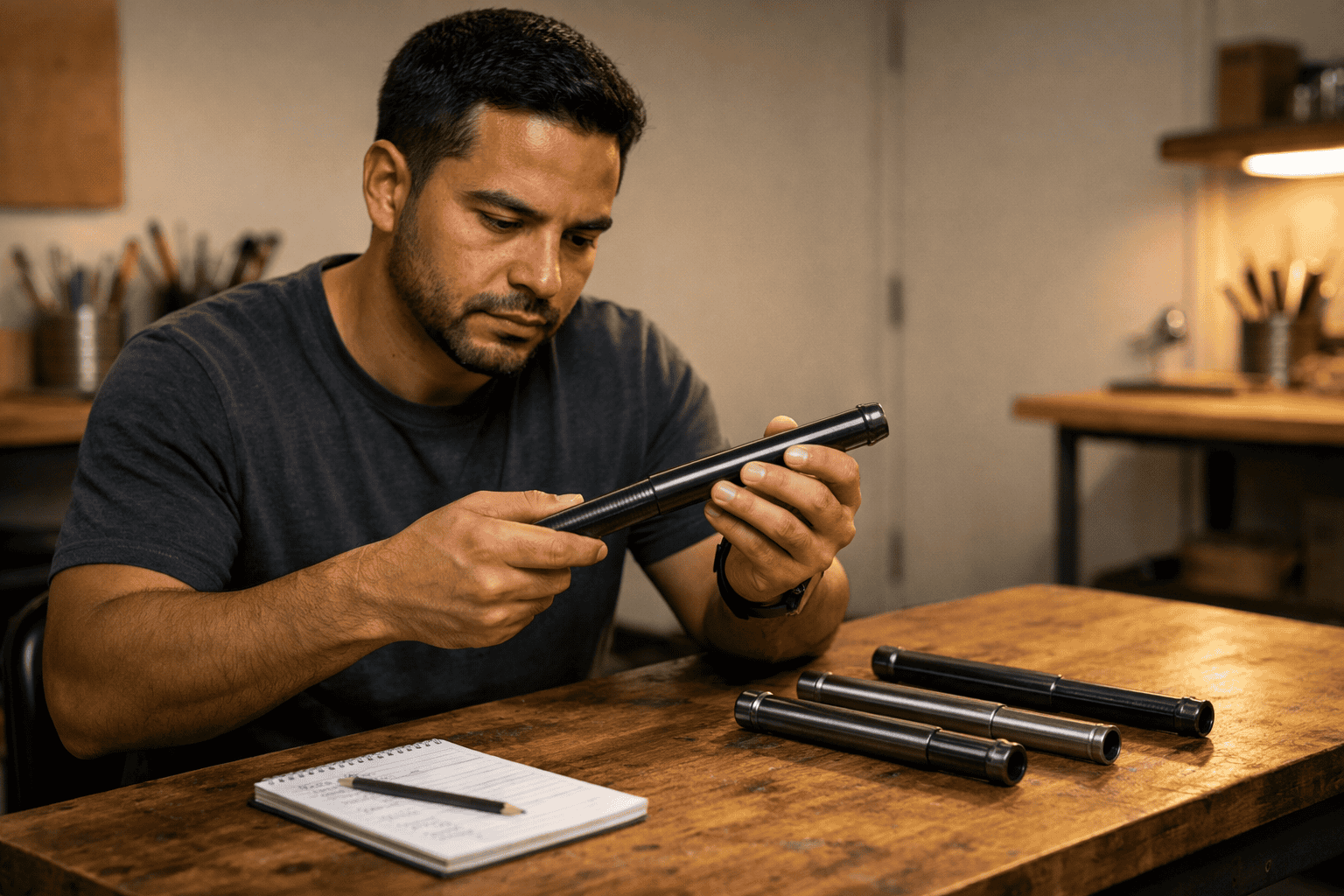
When you’re evaluating a baton in person, hold it, feel its weight, and look at the seams and joints. Quality construction is obvious when you know what you’re looking for. A baton that feels flimsy in your hand will feel worse when you need it most.
How Reliable Is the Expansion Mechanism – and Why This Is the One You Cannot Skip
This is number three, and this is the one that gets people killed. An expandable baton that doesn’t fully lock open in a real confrontation is worse than no baton at all, because now you’re distracted, you’ve lost time, and you’ve got a partially deployed stick in your hand instead of a ready tool.
Now look – I’ve handled dozens of batons over the years, and the expansion mechanism is where cheap products consistently fall apart. Here’s exactly what you need to test before you trust any expandable baton with your safety:
- Test the deployment force: A quality baton should snap open with a sharp flick of the wrist. If you have to shake it hard multiple times, that mechanism is too stiff and will be unreliable under stress.
- Check the lock: Once expanded, the baton should feel completely rigid. Push against the tip and the middle joint – if there’s any flex or wobble, the lock is not secure.
- Test with gloves on: If you live somewhere cold or you’re wearing work gloves, test the flick deployment with those gloves. Some mechanisms require a precision motion that thick gloves make nearly impossible.
- Collapse and redeploy 10 times: The mechanism should perform consistently every single time. Not eight out of ten. Every time.
- Check for debris tolerance: Real environments have dirt, moisture, and grit. A quality expansion mechanism should not jam from normal environmental exposure.
If you’re buying online and can’t test before purchase, only go with brands that have extensive verified user reviews specifically mentioning reliability under pressure. And always buy from a retailer who stands behind what they sell – that matters more than you’d think.
Does the Grip Give You Enough Control When Your Hands Are Sweating?
Your grip is your connection to the tool – if it slips, everything falls apart. Adrenaline causes your hands to sweat. That’s not a weakness, it’s basic physiology. A baton with a slick or poorly designed handle will rotate or fly from your grip at exactly the wrong moment.
When evaluating grip quality, check for:
- Textured or rubberized coating: Foam, rubber, and aggressive knurling all help maintain control in wet or sweaty conditions
- Handle diameter: The handle should fit your hand comfortably. Too thin and you lose control on impact. Too thick and your grip fatigues quickly.
- Wrist strap: Not every baton has one, but if it does, make sure it’s strong enough to actually retain the baton if your grip loosens
- Balance point: A well-balanced baton feels natural in the hand. If the weight feels off, your swing mechanics suffer
I always tell people – grip a baton the way you’d actually use it. Don’t just pick it up gently. Squeeze it. Swing it carefully in a safe direction. See how it feels when you’re applying actual force. That’s the test that matters.
Does the Size of the Baton Match How and Where You Plan to Carry It?
A baton you leave in your car because it’s too bulky to carry is a baton that will not be there when you need it. Size and carry compatibility are non-negotiable considerations that most buyers think about last – and that’s backwards.
Walk through this checklist before you decide on a size:
- Collapsed length: Most expandable batons collapse to between 6 and 9 inches. The shorter, the easier to carry concealed on your person.
- Extended length: Standard options range from 16 to 26 inches. Longer gives you more reach and striking power, but is harder to maneuver in tight spaces like a car interior or narrow hallway.
- Carry method: Where are you carrying this – belt clip, bag, glove compartment, jacket pocket? Match the collapsed size to your actual carry method, not your ideal scenario.
- Your physical size: A smaller person can generate excellent force with a 16-inch baton. A larger person may want 21 to 26 inches for optimal leverage. One size does not fit all.
- Intended environment: Parking lots and open spaces favor longer reach. Enclosed spaces like an office or home hallway favor compact options.
The baton that’s always with you is infinitely more valuable than the perfect baton sitting at home. Choose what you’ll actually carry, every day, without thinking twice about it.
Frequently Asked Questions About Self-Defense Batons
No, they are not. Expandable batons are illegal to carry in several states including California, Massachusetts, and New York, among others. Laws vary significantly by state and even by city or county. Always research your specific jurisdiction before purchasing. Carrying an illegal baton can result in criminal charges even if you never use it. When in doubt, consult a local attorney before buying.
What is the difference between a side-handle baton and an expandable baton?
A side-handle baton, like a traditional PR-24, has a perpendicular handle attached near one end and is typically fixed length – it does not collapse. An expandable or collapsible baton telescopes open with a flick of the wrist for easy carry and deployment. For civilian self-defense carry, expandable batons are generally more practical due to their compact collapsed size and ease of concealment.
How much force can a self-defense baton deliver?
A properly deployed expandable baton can deliver significant impact force – enough to deter or stop an attacker when strikes are directed at the appropriate target areas like the arms, legs, or knees. The actual force depends on the user’s strength, technique, the baton’s weight, and its length. A baton is a serious defensive tool and should never be used casually or without proper understanding of the consequences of use.
Do I need training to use a self-defense baton effectively?
Yes, training is strongly recommended. Owning a baton is not the same as knowing how to use one effectively under stress. Basic training teaches proper grip, deployment under pressure, targeting for defensive purposes, and the legal considerations of use of force. Even a single class or instructional video review will dramatically improve your ability to use the tool correctly when it counts most.
How do I maintain an expandable baton to keep it functioning reliably?
Keep the baton clean and free of dirt, grit, and moisture that can interfere with the expansion mechanism. Periodically apply a light lubricant to the joints and collar – but avoid heavy oils that attract debris. Test the deployment mechanism regularly, at least once a month. Inspect for any signs of corrosion, bending, or weakening at the joints. Store it in a dry environment away from extreme heat or cold.
Can a baton be used for home defense as well as everyday carry?
Absolutely. A baton can be an effective home defense tool, particularly in situations where a firearm is not accessible or appropriate, or where close-quarters defense is needed. For home defense, a slightly longer extended length – 21 to 26 inches – provides better reach. Keep it somewhere accessible in your home, not buried in a drawer. A tool you can’t reach in seconds is a tool you don’t have.
What should I look for in a baton holster or carry case?
Look for a holster with a secure retention system that keeps the baton locked in place during normal activity but allows for fast, one-handed draw. Belt-mounted nylon or leather holsters are most common. Make sure the holster fits your specific baton model – an oversized holster can allow the baton to fall or shift. Test the draw repeatedly so the motion becomes automatic before you ever need it in a real situation.
Is a heavier baton always better for self-defense?
Not necessarily. A heavier baton delivers more impact force, but it also fatigues your hand and wrist faster and is harder to carry daily. The best baton is the one you will consistently carry and can control effectively under stress. For most people, a mid-weight aircraft aluminum baton in the 21-inch range strikes the right balance between portability, daily carry comfort, and meaningful defensive capability.
What Is the Bottom Line on Choosing the Right Self-Defense Baton?
Now look – a baton is one of the most underrated self-defense tools available. It’s effective, it doesn’t require a license in most places, and it gives you real stopping power without lethal force. But only if you buy the right one. A baton that’s illegal, poorly built, mechanically unreliable, slippery in your hand, or too big to actually carry is worse than nothing – because you might depend on it and it will let you down.
Run through those five checkpoints before you buy anything. Legality. Material. Expansion mechanism reliability. Grip quality. Size and carry compatibility. Check all five every time. Don’t rush it. Don’t guess. And don’t skip number three – that expansion mechanism is the heart of the tool, and if it doesn’t work flawlessly, nothing else matters.
You don’t have to carry a gun. But carry something – and make sure it’s something you can count on. Stay safe out there.