Stand Your Ground Laws 2026 Explained: Which States Protect Your Rights to Defend Yourself
Quick Answer: Stand Your Ground laws remove the legal duty to retreat before using force in self-defense – meaning if you’re in a place you have a legal right to be and you reasonably believe you face imminent serious harm, you can defend yourself without first trying to escape. As of 2026, approximately 30 states have some form of Stand Your Ground protection, though the exact language and legal thresholds vary significantly from state to state. Knowing your state’s law before you ever reach for a self-defense tool is not optional – it’s critical.
What Exactly Is a Stand Your Ground Law?
Stand Your Ground is a legal doctrine that eliminates the duty to retreat in self-defense situations. Before these laws existed, many states required a person to first attempt to escape danger before using force – even if they were completely justified in defending themselves. Stand Your Ground flipped that requirement. If you’re somewhere you have a legal right to be, you have the legal right to hold your ground.
Now look – this doesn’t mean you can escalate a situation and then claim self-defense. The core elements still apply:
You must reasonably believe you face imminent death or serious bodily harm
You must not have provoked or initiated the confrontation
You must be in a location you’re lawfully allowed to occupy
The force used must be proportionate to the perceived threat
These are not loopholes. Every one of these elements will be examined if you ever have to defend yourself in court. Understanding them could be the difference between going home and going to prison.
How Is Stand Your Ground Different from Castle Doctrine?
Castle Doctrine is the foundation – Stand Your Ground is the expansion. Here’s the breakdown:
Castle Doctrine gives you the right to defend yourself without retreating inside your home, your vehicle, or your place of business. The phrase comes from the old English legal concept that a man’s home is his castle. Almost every state in the U.S. has some version of Castle Doctrine.
Stand Your Ground extends that protection beyond your home – to parking lots, sidewalks, parks, stores, and anywhere else you have a legal right to be. That’s the key distinction. Castle Doctrine protects you inside. Stand Your Ground protects you outside too.
Here’s the thing – if you’re walking to your car after a late shift and someone corners you, Castle Doctrine does nothing for you in that parking lot. Stand Your Ground does. That’s why knowing which doctrine applies in your state matters on a practical level, every single day.
Which States Have Stand Your Ground Laws?
I’m gonna tell you right now – this list changes as legislatures update statutes, so always verify with your state attorney general’s office or a licensed attorney in your state. That said, as of 2026, the following states have clear Stand Your Ground protections either through statute or established case law:
Alabama
Alaska
Arizona
Arkansas
Florida
Georgia
Idaho
Indiana
Iowa
Kansas
Kentucky
Louisiana
Michigan
Mississippi
Missouri
Montana
Nevada
New Hampshire
North Carolina
North Dakota
Ohio
Oklahoma
Pennsylvania
South Carolina
South Dakota
Tennessee
Texas
Utah
West Virginia
Wyoming
Important warning: Some states apply Stand Your Ground selectively – for example, only when deadly force is used, or with specific exclusions for certain locations or circumstances. Pennsylvania, for instance, has Stand Your Ground outside the home but a duty to retreat in public under some interpretations of case law. Do not assume your state’s version is identical to another state’s.
Woman Holding A Personal Alarm
Which States Still Require You to Retreat?
Several states maintain a legal duty to retreat before using force – meaning if you could have safely escaped the situation, the law may require you to have tried. These states generally include:
Connecticut
Delaware
Hawaii
Maine
Maryland
Massachusetts
Minnesota
Nebraska
New Jersey
New York
Rhode Island
Wisconsin
Even in duty-to-retreat states, there are exceptions – particularly in your home under Castle Doctrine. And in most of these states, if retreat was genuinely impossible or would have increased your danger, a court may still find your use of force justified. But the burden is on you to demonstrate that.
If you live in or frequently travel through a duty-to-retreat state, this changes how you need to think about your self-defense tools and your response plan. A personal alarm or pepper spray that creates distance or deters an attacker without escalating to deadly force may carry very different legal weight than other tools in these jurisdictions.
What Are the Real-World Mistakes People Make Under Stand Your Ground?
Owning the legal right to stand your ground and successfully using it as a legal defense are two different things. Here are the most common and dangerous mistakes people make:
Verbal escalation before physical defense. If you provoked the confrontation – even just with aggressive words – you may have forfeited your Stand Your Ground protection. Keep your mouth in check.
Continuing force after the threat stopped. Stand Your Ground covers the threat, not retaliation. The moment an attacker is no longer a threat, force must stop.
Being in a place you weren’t legally allowed to be. If you were trespassing, Stand Your Ground typically doesn’t apply.
Not calling police immediately afterward. How you report an incident shapes the narrative. Call 911. State that you were attacked and defended yourself. Then wait for your attorney.
Carrying a self-defense tool you don’t know how to use. A stun gun buried at the bottom of a bag under adrenaline and fear does you no good. Every tool requires regular practice and immediate accessibility.
How Do Stand Your Ground Laws Affect Your Choice of Self-Defense Tools?
This is good for any law-abiding person to think through before they ever face a threat. Your legal environment and your self-defense tool should match each other.
In Stand Your Ground states, you have more flexibility in how you respond to a threat in public – but the reasonableness standard still applies. Using deadly force against someone who shoved you once is not going to fly legally, regardless of your state’s Stand Your Ground statute.
Here’s a practical self-defense tool checklist based on threat level:
Personal alarm: Legal everywhere, requires zero legal justification to use, creates immediate attention and may deter an attacker without any physical confrontation
Pepper spray: Non-lethal, widely legal, effective at creating distance – ideal when you want to neutralize a threat without escalating to potentially deadly force
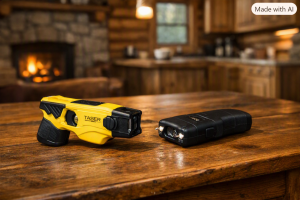
Stun gun or TASER device: Temporary incapacitation, non-lethal, subject to state-specific carry restrictions – check your local laws
Firearm: Deadly force – the highest bar of legal justification, every state requires imminent threat of death or serious bodily harm
I always say: you don’t have to carry a gun, but carry something. And whatever you carry, carry it where you can actually reach it in the first three seconds of a confrontation. Because that’s all you get.
|Woman Pepper Spraying a Deer
What Should You Do Immediately After a Self-Defense Incident?
This section could save you from making a bad situation catastrophically worse. Follow these steps in order:
Ensure you are safe first. Get distance from the threat before anything else.
Call 911 immediately. Being the first to report puts you in a stronger legal position as the victim. State clearly: you were attacked, you defended yourself, and give your location.
Do not move anything at the scene if at all possible.
Do not give a detailed statement to police without an attorney present. You can and should say: “I was in fear for my life and I defended myself. I want to cooperate fully but I need to speak with my attorney first.”
Document everything you can remember as soon as possible – time, lighting, what was said, what happened, who witnessed it.
Contact a self-defense attorney – even if you believe you were completely in the right. Stand Your Ground is a legal defense, not an automatic pass. An attorney helps you assert it properly.
Frequently Asked Questions About Stand Your Ground Laws
No – and this is a critical point. Stand Your Ground removes the duty to retreat, but it does not eliminate the proportionality requirement. The force you use must match the threat you face. Using deadly force to stop a shove will not be protected under Stand Your Ground. The law requires that your belief of imminent serious harm be reasonable, and the force you used be proportionate to that threat.
If I’m in a Stand Your Ground state, do I still need to worry about legal consequences?
Absolutely. Stand Your Ground is an affirmative defense, meaning you still may be arrested, charged, and required to prove in court that your use of force was justified. It is not a guaranteed get-out-of-jail card. Prosecutors can and do challenge Stand Your Ground claims. You will need documentation, witnesses, and ideally a skilled self-defense attorney to successfully assert this defense.
Can I use Stand Your Ground to defend someone else?
In most Stand Your Ground states, yes – the defense of others doctrine allows you to use the same level of force in defense of another person that you would be permitted to use in defense of yourself. The same standards apply: reasonable belief of imminent serious harm and proportionate response. However, the specifics vary by state, so verify the exact language in your jurisdiction before assuming this applies.
Does Stand Your Ground apply if I’m in my car?
In most Stand Your Ground states, yes. Your vehicle is typically considered a place you have a legal right to occupy. Some states explicitly extend Castle Doctrine protections to vehicles as well. If someone attempts to carjack you or breach your vehicle with clear threatening intent, many states allow you to use force without first attempting to exit the vehicle. Check your specific state statute for vehicle-specific language.
Are there places where Stand Your Ground doesn’t apply even in Stand Your Ground states?
Yes. Common exceptions include situations where you were engaged in criminal activity at the time, where you were trespassing, or where you were the initial aggressor in the confrontation. Some states also exclude Stand Your Ground protections in cases involving law enforcement interactions. Location-specific rules – such as in bars or at certain public events – may also apply depending on your state’s statute.
What self-defense tools are legal to carry in duty-to-retreat states?
Most non-lethal tools – personal alarms, pepper spray, and in many cases stun guns – are legal in duty-to-retreat states, though specific restrictions vary. Firearms are legal in most but require permits in many of these states. The important distinction is not just what’s legal to carry, but what level of force you’re legally permitted to use in a public confrontation before exhausting retreat options. Know your state’s specific statutes.
Does carrying a self-defense product make me more likely to end up in a legal situation?
Not if you use it correctly and lawfully. A self-defense tool is not an invitation to confront danger – it’s a last resort when danger finds you and escape is not an option. The risk of legal exposure comes from improper use, not from carrying the tool itself. Training, awareness, and knowing your state’s laws dramatically reduce the chance that a defensive action creates a legal problem for you.
How do I find out the exact Stand Your Ground law in my state?
Start with your state legislature’s official website – most publish the full text of statutes online at no cost. Search your state name plus “self-defense statutes” or “justification for use of force.” For real-world application, consult a licensed criminal defense attorney in your state who specializes in self-defense cases. Laws and case interpretations update regularly – what was true three years ago may have been revised.
The Bottom Line: Know Your Law Before You Need It
Stand Your Ground laws exist to protect people who are forced into situations they didn’t choose and couldn’t escape. But the protection only works if you understand the boundaries – the reasonableness standard, the proportionality requirement, the legal locations, and the prohibition against being the aggressor. Knowing your state’s law isn’t just legal homework. It’s part of being a responsible, prepared person.
Whatever state you’re in, whatever tool you carry – a personal alarm, pepper spray, a stun gun, or a firearm – carry it because you’ve thought it through. Because you’ve trained with it. Because you know exactly when and how the law allows you to use it. That’s not paranoia. That’s preparation.
Stay safe out there, and may you and your loved ones stay protected.
With over 25 years in the Self Defense Industry, Jose Diaz has provided lots of advise to those seeking to protect themselves against danger. Jose is a hard working individual who has use his skills to address the many faults of self protection in our society. As a father, Grandfather and a Great grandfather he wants to keep his family safe. This is why he has created his business, "Brainstorm Security Shop". He wants to provide people with a choice to defend themselves in case of a personal attack. His self-defense gadgets, like stun guns, pepper sprays, knifes, personal alarms and others will provide protection against any attacker. Please take a look at his products since very well can save your life in case of a personal attack. May you and your loved ones be safe and enjoy a long and prosperous life.