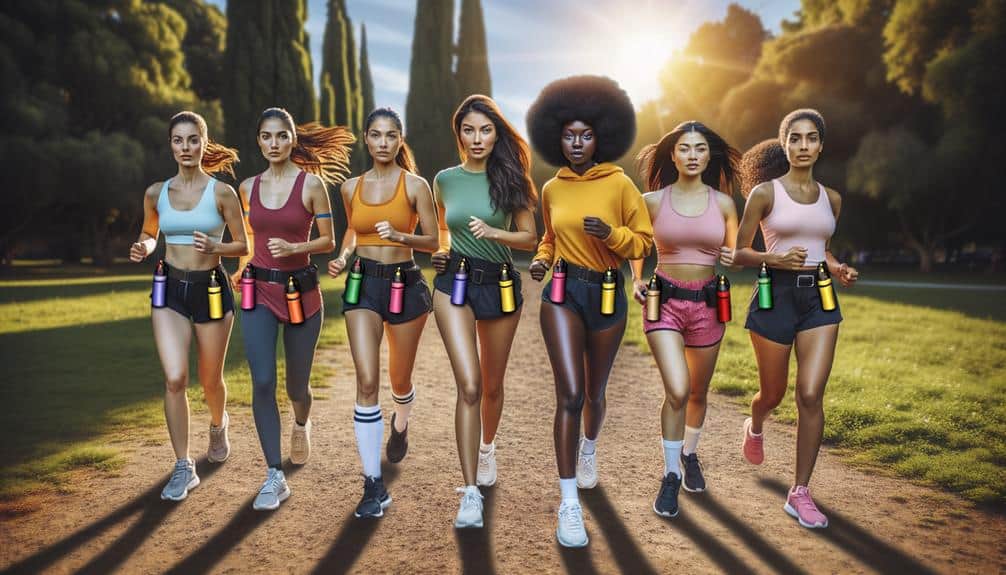
Serious runners carry three things: a defense tool they can reach in under two seconds, a way to be located if something goes wrong, and identification in case they can’t speak for themselves. The best setup depends on your route, but a hand-worn defense tool paired with a fitted running belt beats anything you have to dig for. Where you carry it matters as much as what you carry — a tool buried in a pocket is a tool you won’t use in time.
Why does gear placement matter more than gear selection?
Because a product you can’t reach instantly is a product that doesn’t exist when you need it. This is the distinction that separates women who’ve actually thought this through from women who bought something once and never touched it again. Anyone can order a can of pepper spray. Fewer women take the extra step of deciding exactly where it lives on their body during a run — and that decision is the one that actually saves seconds.
Here’s the thing: the average confrontation unfolds in three to five seconds. That’s not a lot of time to unzip a pocket, dig past your phone and your keys, and find what you’re looking for. Women who run seriously — who treat their safety with the same discipline they bring to their training — build a system. The tool has a home. Their hand knows exactly where to go without looking.
This is why we spend more time talking about placement than product specs. A premium tool in the wrong spot underperforms a basic one that’s instantly accessible. Get the placement right first.
What should a woman actually carry when running alone?
A serious running safety kit has three components: an immediate defense tool, a way to signal for help, and identification. Nothing more, nothing less — anything extra just becomes weight and friction.
Your defense tool should be something designed for movement, not something designed to sit in a purse. A compact pepper spray built for runners — something with a hand strap so it stays secured to your palm through every stride — is the standard here. We cover the specifics of what separates a runner’s pepper spray from a general-purpose one in our breakdown of pepper spray options built for women on the move, but the short version is this: if it doesn’t stay in your hand without effort, it’s not built for running.
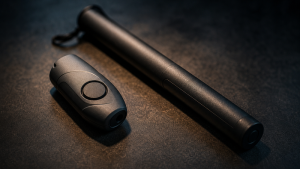
Some women prefer a contact weapon over a spray, particularly on routes where wind direction is unpredictable or distance matters. A discreet stun device made for women’s hands — something that doesn’t look or feel like a bulky tactical tool — fills that role well. Look at what’s available in stun guns for women if that’s the direction you’re leaning. A personal alarm rated at 130 decibels or higher is worth adding too — it does something a defense tool alone cannot: it draws attention from anyone nearby, immediately, without you having to say a word.
Where should you actually carry it — pocket, belt, or hand?
In your hand, whenever possible. That’s not a suggestion — it’s the standard serious runners hold themselves to. A tool in your hand requires zero reaction time. A tool in a pocket requires you to notice a threat, process it, reach for the tool, and deploy it — all before the situation has already escalated.
When hand-carry isn’t practical, a fitted running belt worn at the front of your waist is the next best option. Not a pocket. Not a bag slung over your shoulder. A belt keeps the tool at your fingertips and keeps your hands free for balance and stride. The women who take their safety seriously don’t treat this as optional gear — they treat it the way they treat proper running shoes: non-negotiable, fitted correctly, and tested before it’s ever needed.
A compact self-defense keychain earns its place here too, precisely because it clips directly to a belt loop, bag strap, or the drawstring of your running shorts — no digging required. Something like a cat self-defense keychain combines a discreet striking tool with your existing keys, so it’s already in your hand the moment you grab your house key on the way out the door. Browse the full range of self-defense keychains for women to find one that fits your grip and your routine.
Do you need more than one defense tool?
Layering matters, but only if each layer earns its place. A woman who’s serious about her safety doesn’t carry three redundant tools — she carries tools that cover different distances and different scenarios.
Pepper spray handles distance. It stops a threat before it reaches you. A stun device or compact knife handles what happens if a threat closes that distance anyway. A knife built for everyday carry — small, legal in your state, and easy to open with one hand — is the layer many experienced runners add once they’ve mastered their primary tool. We go deeper on knife selection specifically for women in our guide to the best self-defense knives for daily carry.
The point isn’t to carry everything. It’s to carry exactly what covers your actual risk, and to know each piece cold — not fumble through options you never trained with.
How do you make sure you can actually use it under pressure?
You practice with it before you ever need it — full stop. This is the step most women skip, and it’s the one that separates preparation from false confidence. Owning a defense tool and knowing how to deploy it under adrenaline are two entirely different things.
Practice deploying your pepper spray with the safety mechanism engaged, so you build the muscle memory without discharging it. Practice reaching for your stun device from your belt with your eyes closed. Run with your gear on for a week before you trust it on a solo route at dusk. This is what women who take their safety seriously actually do — they treat their gear like a skill, not a purchase.
If you’re carrying anything with legal restrictions in your state — certain stun devices in particular — it’s worth reading our state-by-state breakdown of taser laws before you build your kit, so what you’re carrying is actually something you’re allowed to use.
What else should be part of a serious runner’s safety routine?
Route awareness and communication matter as much as the gear itself. Share your live location with someone before you leave. Vary your route so it’s not entirely predictable to anyone watching a pattern. Run against traffic where applicable so you can see what’s approaching. None of this replaces a physical defense tool — it supplements it.
Identification matters more than most runners think about until they need it. A simple ID clipped to your shoe or belt means that if you’re ever unable to speak for yourself, first responders aren’t starting from zero. This is a small addition, but it’s the kind of detail that separates a truly complete safety routine from one that only looks complete.
Frequently Asked Questions About Safety Gear for Women Running Alone
What’s the best self-defense tool for a woman running alone?
A compact pepper spray with a hand strap designed for runners is generally the top choice because it stops a threat at distance without requiring physical contact. Pair it with a personal alarm for added attention-drawing power. The right choice ultimately depends on your comfort level, your route, and how consistently you’ll actually carry and practice with it.
Should I carry pepper spray or a stun gun while running?
Pepper spray is generally better suited to running because it works at a distance and doesn’t require grip strength or contact. A stun gun is a strong secondary layer for close-range situations but requires you to be within arm’s reach of a threat. Many serious runners carry both, positioned for different distances.
Where should I keep my pepper spray while running?
In your hand, secured with a strap, is the gold standard. If that’s not practical, a fitted running belt at the front of your waist is the next best placement. Avoid pockets and bags — both require too many steps to access under pressure.
Is a personal alarm actually useful for runners?
Yes. A loud personal alarm, ideally rated at 130 decibels or higher, draws immediate outside attention and can startle or deter an attacker without any physical contact required. It works well as a layer alongside a defense tool, not as a replacement for one.
Can I carry a knife while running?
In many states, yes, provided the blade length and type comply with local law. A compact, one-handed knife built for everyday carry can serve as a close-range backup layer. Always confirm your state’s specific restrictions before adding a knife to your kit.
How do I practice using my defense gear safely?
Practice the physical motion of reaching for and deploying your tool with the safety engaged or the unit unloaded, so you build muscle memory without discharging it. Run with the gear on for several outings before relying on it during a solo run at a less familiar time or route.
What should I do if I don’t want to carry anything visible?
Choose gear designed to be discreet by default — a self-defense keychain that doubles as your house key, or a slim stun device sized to fit a closed hand. Discreet doesn’t mean less effective; it means the tool blends into your routine so you’re more likely to actually carry it every time.
Is it legal to keep a stun gun or taser in my car for after my run?
Laws vary significantly by state, and this is worth confirming before you rely on it. Our guide on keeping a taser in your car covers what you need to know before making that part of your routine.