In most states, felons are prohibited from legally owning or possessing a Taser or stun gun — but the rules are not the same everywhere, and the gray areas can land someone in serious legal trouble. Federal law doesn’t explicitly ban felons from possessing electronic control devices the way it bans firearm ownership, so the question falls almost entirely to state law. That’s exactly why you need to know the specific rules for your state before you buy, carry, or even touch one of these devices.
Why do people assume Tasers are legal for felons?
Here’s the thing — a lot of people confuse “not a firearm” with “no restrictions.” Tasers and stun guns are not firearms under federal law, which means the federal prohibition on felons owning firearms doesn’t automatically apply. That logic sounds reasonable on the surface, but it’s dangerously incomplete. Many states have written their own laws that specifically classify electronic control devices alongside other dangerous weapons — and those state laws can and do prohibit felons from owning them. Assuming you’re in the clear because it’s “not a gun” is the kind of mistake that turns a self-defense purchase into a felony charge.
What does federal law actually say about felons and Tasers?
Federal law — specifically the Gun Control Act — prohibits convicted felons from purchasing, possessing, or transporting firearms and ammunition. Tasers and stun guns do not fall under the federal definition of a firearm, so there is no blanket federal prohibition on felon ownership of these devices. That’s the full extent of what federal law tells us on this topic. Everything beyond that is governed by state law, and state laws vary dramatically. Do not let the absence of a federal ban give you a false sense of security.
Which states explicitly ban felons from owning Tasers or stun guns?
Several states have laws on the books that directly restrict or outright prohibit felon possession of electronic control devices. The list below is not exhaustive and laws change — always verify with a licensed attorney in your state. That said, here are examples of how states approach this issue:
Illinois: State law prohibits felons from possessing “stun guns” and specifically includes electronic control devices in weapon restrictions for people with prior convictions.
Michigan: Michigan law restricts the possession of Tasers by individuals with felony convictions.
Hawaii: Stun guns and Tasers are heavily regulated statewide, and felons face additional restrictions on top of general prohibitions.
Rhode Island: Electronic weapons are restricted for people with prior felony convictions.
New York: Stun guns were previously banned entirely. Following legal challenges, possession became more permitted — but restrictions still apply to those with felony convictions.
California: Felons are explicitly prohibited from owning or possessing stun guns or Tasers under state law.
Wisconsin: State law restricts electric weapon possession, and prior felony convictions are a disqualifying factor.
Now look — that list should make it very clear: this is not a loophole situation. These are real criminal statutes with real consequences. Getting caught in violation of a state weapons law as a convicted felon often results in another felony charge. We’re not talking about a fine and a warning.
Are there states where felons can legally own a stun gun?
Yes, there are states that do not specifically restrict Taser or stun gun ownership for felons. Some states have minimal or no regulations on stun guns in general, and those statutes may not include prior conviction language. Texas, for example, generally allows stun gun ownership without a felony-specific prohibition in its stun gun statutes — though other weapon enhancement laws could still apply depending on circumstances. Florida similarly does not have a stun-gun-specific felony restriction in its general statutes, though again, context matters. The fact that a state doesn’t specifically ban it doesn’t always mean the path is completely clear — a prosecutor can still argue that a stun gun qualifies as a “dangerous weapon” under broader statutes, which can carry serious weight in sentencing for someone with a prior record.
What’s the difference between a Taser and a stun gun — and does it matter legally?
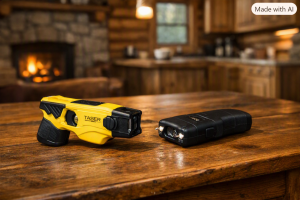
Taser Gun
It can matter, depending on how your state’s law defines the restricted device. A Taser — technically a brand name for a conducted energy device — fires probes attached to wires that deliver an electric charge from a distance. A stun gun requires direct contact with the target. Some state statutes use the term “stun gun” and courts have had to decide whether that language also covers Tasers. Other states use broader language like “electronic control device” or “electric weapon” that sweeps in both. I’m gonna tell you right now — if you’re a felon trying to sort this out, the distinction between these two devices is exactly the kind of technical detail that can go either way in court. Get proper legal counsel before you assume your specific device is or isn’t covered.
What happens if a felon is caught with a Taser illegally?
The consequences are serious and should not be minimized. Depending on the state, a felon caught in possession of a prohibited weapon — including an electronic control device — can face:
A new felony charge for unlawful possession of a weapon, which adds to the existing criminal record
Mandatory prison time in states with sentencing enhancements for repeat offenders or prohibited persons
Probation or parole violation if the individual was already under supervision, which can result in immediate incarceration
Enhanced sentencing if the device was possessed during the commission of another crime
This isn’t scare tactics — it’s reality. A stun gun that someone bought thinking they were finding a legal workaround around firearm restrictions can become the thing that sends them back to prison. That’s a bad outcome for everyone involved, including the person who genuinely wanted it for self-defense.
Can a felon’s civil rights restoration affect Taser ownership?
In some states, yes. Certain states allow for the restoration of civil rights — including gun rights — after a felony conviction, through a pardon, expungement, or formal restoration process. In those cases, restored rights may also remove the restriction on owning electronic weapons, depending on how the law is written. However, this is highly state-specific and even restoration of firearm rights doesn’t automatically guarantee all weapon restrictions are lifted. If you’ve gone through a rights restoration process and you’re wondering whether it covers stun gun or Taser ownership, you need to ask an attorney — not a retail store, not a forum, and definitely not someone who says they heard it was fine.
What self-defense options might be legally available to felons?
This is good for people who genuinely need to think through their options carefully. If a Taser or stun gun is off the table legally, there are still lawful self-defense tools worth considering — but again, always verify what’s legal in your state:
Pepper spray: Most states allow pepper spray ownership without prior conviction restrictions, though some states do limit canister size or concentration levels. Verify your state’s specific rules.
Personal alarms: Loud personal alarms are universally legal, non-weapon devices that can deter attackers and alert bystanders. No legal restrictions anywhere.
Tactical flashlights: Not classified as weapons in any state, these can be carried legally and serve both practical and defensive purposes.
Self-defense classes: Your body and your awareness are the most important tools you have. Training in situational awareness and hand-to-hand defense carries no legal risk.
You don’t have to carry a gun, but carry something — and make sure that something is legal for you to carry. That’s the whole point.
Frequently Asked Questions
Can a felon own a Taser in Texas?
Texas law does not have a specific felony-prohibition statute targeting Taser or stun gun ownership the way it does with firearms. However, felons should be cautious — if a stun gun is used in the commission of a crime or if other weapon enhancement laws apply, prior conviction status can still increase criminal exposure significantly. Always consult a Texas-licensed attorney before making any decision about weapon ownership.
Can a felon own a Taser in California?
No. California law explicitly prohibits convicted felons from purchasing, owning, or possessing stun guns and Tasers. Violating this prohibition is a criminal offense that can result in new charges and additional incarceration. California is one of the clearest states on this issue — the prohibition is written directly into the Penal Code and there is no ambiguity about it applying to people with felony convictions.
No. Under the federal Gun Control Act, a “firearm” is defined as a weapon that expels a projectile by action of explosive. Tasers and stun guns use electrical current, not explosive propellant, so they do not meet the federal definition of a firearm. This means the federal felony-firearm prohibition does not apply directly — but state laws often fill that gap with their own restrictions on electronic weapons.
Does a misdemeanor conviction affect Taser ownership?
Generally speaking, misdemeanor convictions don’t trigger the same weapon restrictions as felonies — but there are exceptions. Misdemeanor domestic violence convictions, for example, trigger a federal firearm ban. Some states also restrict weapon ownership for certain classes of misdemeanor offenders. If your prior conviction was a misdemeanor, the restrictions are less common but shouldn’t be assumed away without checking your state’s specific statutes.
Can a felon own a Taser if their record was expunged?
It depends entirely on your state’s expungement laws and how those laws define restored rights. Some states treat an expunged record as fully cleared, restoring all civil rights including weapon ownership. Others limit what expungement actually restores. Do not assume an expungement automatically lifts all weapon restrictions. Get written confirmation from an attorney who practices criminal law in your state before purchasing any weapon — electronic or otherwise.
What is the difference between a Taser and a stun gun legally?
Legally, the distinction depends on how your state defines restricted devices. Some states use “stun gun” as the operative term, which may or may not include Tasers by legal interpretation. Others use broader language like “electronic control device” that covers both. Courts in different states have ruled differently on this question. If you are relying on a technical distinction between these two devices to justify ownership, that’s a legal strategy — not a shopping decision — and it requires an attorney.
Are personal alarms legal for felons?
Yes. Personal alarms are not classified as weapons in any U.S. jurisdiction. They emit a loud sound to attract attention and deter attackers, and they carry zero legal restrictions for anyone, including individuals with felony convictions. They’re not a substitute for other self-defense tools in every scenario, but they’re a legitimate, accessible, and completely legal option that anyone can carry and use without legal concern.
Should a felon ask a store employee whether a Taser is legal for them to own?
No — and I want to be direct about this. Retail employees, including knowledgeable ones, are not licensed to give legal advice and their answers carry no legal protection for you. The only person qualified to tell you whether a specific weapon is legal for you to own given your conviction history and your state of residence is a licensed attorney. Use store employees to learn about products; use attorneys to learn about your legal rights.
The bottom line on felons and Taser ownership
Here’s the honest summary: whether a felon can legally own a Taser depends almost entirely on state law, the nature of the conviction, whether rights have been restored, and how the state defines the restricted device. There is no universal yes or no answer — which is exactly why this question is so dangerous to get wrong. Making an assumption and acting on it can result in a new criminal charge that follows you for the rest of your life.
If you’re a felon who wants to be prepared and protected, I respect that. The desire to protect yourself and the people you care about is completely legitimate. But I’m going to tell you right now — do it legally. Talk to an attorney. Find out exactly what you can and cannot carry in your state. Then come find the right tool for your situation. Pepper spray, personal alarms, situational awareness training — there are real options on the table that don’t carry legal risk. The goal is to stay safe without putting yourself back in a situation that costs you your freedom.
With over 25 years in the Self Defense Industry, Jose Diaz has provided lots of advise to those seeking to protect themselves against danger. Jose is a hard working individual who has use his skills to address the many faults of self protection in our society. As a father, Grandfather and a Great grandfather he wants to keep his family safe. This is why he has created his business, "Brainstorm Security Shop". He wants to provide people with a choice to defend themselves in case of a personal attack. His self-defense gadgets, like stun guns, pepper sprays, knifes, personal alarms and others will provide protection against any attacker. Please take a look at his products since very well can save your life in case of a personal attack. May you and your loved ones be safe and enjoy a long and prosperous life.