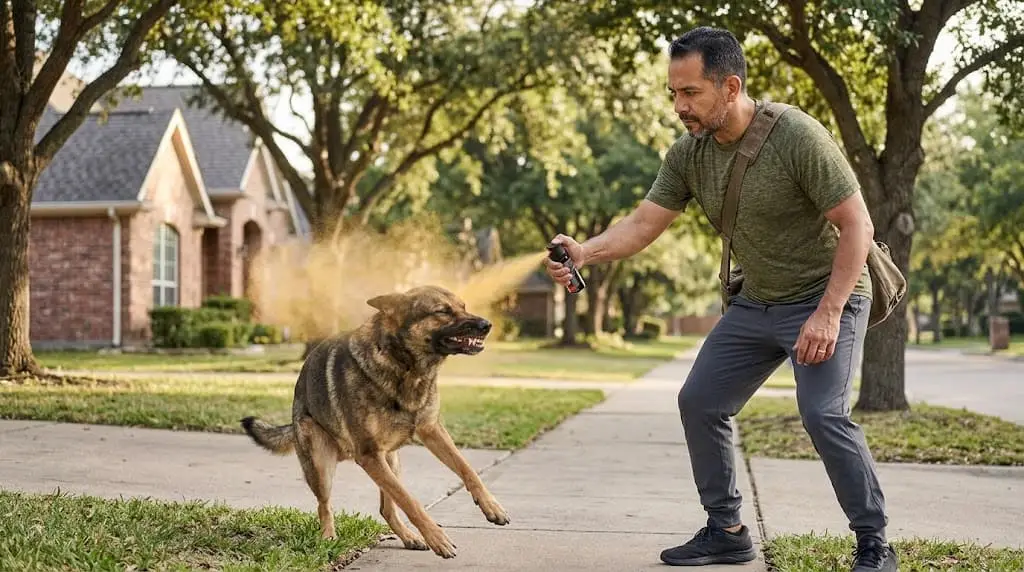
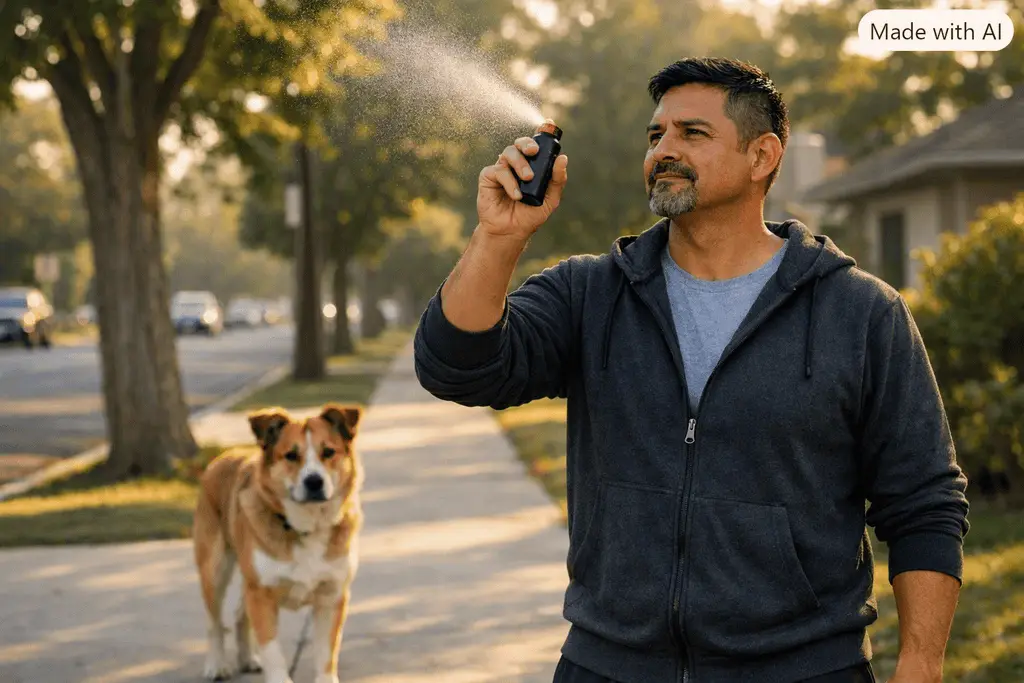
Yes, pepper spray — commonly called mace — can absolutely stop a dog attack, and it works well when used correctly. It’s one of the most effective non-lethal tools available for deterring an aggressive dog, and I’d argue it’s something every walker, jogger, cyclist, and mail carrier should have within reach. The key is knowing how to use it, when to use it, and which formula is best suited for animals versus people.
How does pepper spray actually stop an aggressive dog?
Pepper spray works on dogs for the same biological reason it works on people — capsaicin, the active compound derived from hot peppers, causes intense irritation to the eyes, nose, mouth, and respiratory tract. Dogs have an extraordinarily powerful sense of smell, which actually makes them more sensitive to the effects of capsaicin than most humans are. A direct shot of pepper spray to a charging dog’s face will cause immediate burning in the eyes and nasal passages, triggering a powerful instinct to stop, retreat, and focus entirely on its own discomfort rather than continuing the attack.
This isn’t a permanent injury — the effects are temporary and typically wear off within 30 to 45 minutes. That’s more than enough time for you to get yourself or your child to safety. The goal isn’t to harm the dog. The goal is to interrupt the attack and create the window you need to escape.
Is regular pepper spray safe to use on dogs?
Standard pepper spray formulated for human attackers will work on a dog, but there are products specifically designed for animal deterrence that are considered a better choice. Dog-specific pepper sprays — sometimes called animal repellent sprays — are typically formulated at a lower concentration of capsaicin than defensive sprays meant for humans. The lower concentration is still highly effective on an animal’s sensitive nose and eyes, while reducing the risk of causing unnecessary harm. If you already carry a human-grade defensive spray, understand that it will still work in an emergency. But if you spend a lot of time walking, running, or cycling in areas where loose or aggressive dogs are a real concern, a dedicated animal repellent spray is worth keeping on your belt clip alongside whatever you carry for personal defense.
Now look, I’m not saying every dog that runs at you needs a face full of spray. A lot of dogs are territorial barkers that stop at the property line. But an animal that’s locked eyes, lowered its head, and is closing ground fast? That’s a different situation entirely. Know the difference, and trust your instincts.
What is the correct way to use pepper spray on a charging dog?
Technique matters — especially when your hands are shaking and your heart rate has tripled. Here’s what you need to understand before the moment arrives:
Get it out early. The worst time to dig through your bag for your spray is when a dog is already three feet away. If you see a dog approaching aggressively from a distance, get your spray in your hand now. You want it out and ready before you need it.
Aim for the face. You want the spray to make contact with the dog’s eyes and nose. Aim at the face from a distance of about 8 to 10 feet if the spray’s range allows. Most good animal repellent sprays have a stream or cone pattern — know yours before you’re in a situation.
Spray in short bursts. A quick, deliberate burst directed at the face is more effective than holding the nozzle down and draining the canister. Short bursts also conserve your spray in case you need more than one application.
Back away, don’t run. Running triggers prey drive. After spraying, back away calmly but quickly. Put as much distance between you and the dog as possible while it’s distracted.
Don’t spray into wind. Be aware of wind direction. Spraying into the wind can blow capsaicin back into your own face — not helpful. If possible, position yourself upwind before deploying.
I’ve talked to postal workers and delivery drivers who carry animal repellent spray every single day on the job. The ones who’ve used it all say the same thing — it worked, the dog stopped, and they got away clean. When you use it right, it does what it’s supposed to do.
How close do you need to be for pepper spray to be effective on a dog?
Most quality pepper sprays have an effective range of 8 to 12 feet, and that’s your sweet spot for deploying against a charging dog. Too far and the spray disperses before making solid contact. Too close and the situation is already more dangerous than it needed to be — and you risk getting the spray on yourself. Practice finding the canister in your hand quickly. Know which way the nozzle points without having to look. That kind of muscle memory is built before the moment, not during it.
Some sprays come in a fogger pattern, which covers a wider area and is particularly useful against fast-moving targets like a running dog. A stream pattern gives you more range and precision but requires better aim under pressure. I generally recommend a cone or fogger pattern for animal defense specifically — dogs move fast and erratically, and the wider coverage gives you a better chance of making effective contact.
Are there situations where pepper spray might not stop a dog attack?
Here’s the thing — no tool works 100% of the time in 100% of situations, and I’ll always be straight with you about that. There are a few scenarios where pepper spray may be less effective:
Wind conditions. Strong wind can significantly reduce the effective range and deflect the spray away from the dog or back toward you.
Extreme aggression or pain insensitivity. A dog that is severely agitated, in a highly adrenaline-fueled state, or has been trained to push through pain stimuli may require more than one application to stop.
Wrong formulation. A very low-concentration spray or an expired canister may not deliver enough capsaicin to produce the deterrent effect quickly enough.
Multiple dogs. A single canister against multiple aggressive dogs is a more complicated situation. You may not have enough spray or enough time to address more than one animal.
None of this means pepper spray isn’t worth carrying. It absolutely is. It just means you carry it as part of an awareness strategy — not as a substitute for paying attention to your surroundings. Awareness is always your first line of defense. The spray is your backup.
Is it legal to use pepper spray on a dog?
In virtually every state in the U.S., using pepper spray to defend yourself against an attacking dog is legally protected. You have a right to defend yourself from injury, and an aggressive dog actively charging you constitutes a genuine threat. Animal repellent sprays are specifically marketed and sold for this purpose, which further reinforces their legitimate defensive use.
That said, laws vary by state and municipality regarding the strength and formulation of pepper spray you can legally carry. Most states allow civilian carry of pepper spray with some restrictions on concentration and canister size. I’d encourage you to look up your local regulations or give us a call — we can help point you in the right direction based on where you live. What I can tell you is that using it appropriately, in genuine self-defense against an attacking animal, is going to be on solid legal ground in the vast majority of situations.
What type of pepper spray is best for stopping a dog attack?
I’m gonna tell you right now — the best spray for dog defense is one that’s formulated specifically for animals, comes in a fogger or cone delivery pattern, has a range of at least 8 feet, and is easy to access quickly. Look for a canister small enough to clip to a belt, leash handle, or bag strap so it’s always within reach. The one that does you no good is the one buried at the bottom of your bag that you can’t get to in three seconds.
Check the expiration date on your spray regularly. Capsaicin potency can degrade over time, and an old, compromised canister is not something you want to discover mid-attack. Replacing your spray every one to two years is a reasonable practice — think of it like changing a smoke detector battery. It’s cheap insurance.
No. Pepper spray causes temporary irritation to a dog’s eyes, nose, and respiratory system, but the effects are not permanent. Most dogs recover fully within 30 to 45 minutes. The spray is designed to deter and disrupt, not to cause lasting injury. It is one of the most humane non-lethal options available for stopping an attacking animal and getting yourself safely away from the situation.
Can I carry dog pepper spray if I already carry personal defense spray?
Absolutely, and many people do. If you frequently walk, jog, or cycle in areas with loose dogs, carrying a dedicated animal repellent spray in addition to your personal defense spray is a smart layered approach. Animal repellent formulas are typically lower in concentration and designed to be effective for that use case. Having both means you have the right tool for each type of threat you might realistically encounter.
How far away should I be when I spray a charging dog?
Aim to deploy your spray at about 8 to 10 feet from the dog, which is within most sprays’ effective range and gives you enough distance to avoid the dog reaching you before the capsaicin takes effect. Getting it out of your hand early — when the dog is still 20 or 30 feet away and approaching aggressively — gives you the best positioning and reaction time before the critical moment arrives.
Does wind affect how well pepper spray works on a dog?
Yes, wind is a real factor. Spraying directly into a strong headwind can reduce the effective range considerably and may blow the spray back toward you. When you have time to think — which admittedly isn’t always during a dog attack — try to position yourself with the wind at your back. Cone and fogger patterns are more susceptible to wind than stream patterns, so factor that into your product choice if you live somewhere consistently windy.
What should I do after using pepper spray on a dog?
Back away calmly but quickly and get yourself to safety. Do not run, as that can re-trigger the dog’s prey drive. Once you are safe, report the incident to local animal control, especially if the dog was loose or its behavior suggests a pattern of aggression. Document any injuries, wash any exposed skin thoroughly with soap and water, and replace your pepper spray canister so you’re not caught without a full one next time.
How do I know if my pepper spray is still good to use?
Check the expiration date printed on the canister — most pepper sprays have a shelf life of two to four years. Beyond the date, the capsaicin concentration can degrade and the propellant can weaken, reducing range and effectiveness. Test-fire a very small burst in a safe, open-air environment every six to twelve months to confirm the propellant is still strong. Replace the canister if expired or if the spray seems weak or inconsistent.
Is mace the same thing as pepper spray?
Mace is a brand name that has become a common term people use interchangeably with pepper spray, much like how people say “Band-Aid” for any bandage. Original Mace formulations used a chemical irritant called phenacyl chloride, but modern Mace-branded products and nearly all consumer defensive sprays today use oleoresin capsicum — capsaicin derived from peppers — as the active ingredient. So when someone says “mace,” they almost always mean pepper spray in practical terms.
The bottom line
Pepper spray is a proven, practical, and legal tool for stopping a dog attack, and it’s one I’d feel comfortable recommending to anyone who spends time outdoors. Whether you’re walking your own dog, jogging through the neighborhood, or delivering packages for a living, having an animal repellent spray clipped and accessible gives you a meaningful advantage if a bad situation unfolds. It won’t replace awareness — nothing does — but it’s the kind of backup that can turn a potentially serious incident into a story you tell later.
At Brainstorm Security Shop, we carry options suited to all kinds of situations and carry styles. If you have questions about what’s right for your routine, reach out — I’m happy to talk it through with you personally. Stay safe out there, and may you and your loved ones always go home protected.
With over 25 years in the Self Defense Industry, Jose Diaz has provided lots of advise to those seeking to protect themselves against danger. Jose is a hard working individual who has use his skills to address the many faults of self protection in our society. As a father, Grandfather and a Great grandfather he wants to keep his family safe. This is why he has created his business, "Brainstorm Security Shop". He wants to provide people with a choice to defend themselves in case of a personal attack. His self-defense gadgets, like stun guns, pepper sprays, knifes, personal alarms and others will provide protection against any attacker. Please take a look at his products since very well can save your life in case of a personal attack. May you and your loved ones be safe and enjoy a long and prosperous life.