Choosing the right expandable baton for security work means matching the tool to your specific environment, your physical build, your training level, and the legal requirements in your jurisdiction — in that order. The right baton deploys fast, holds up under repeated use, fits your carry setup, and backs you up legally if you ever have to use it. Get any one of those factors wrong and you’re carrying dead weight — or worse, a liability.
Now look, I’ve been in this industry for over 25 years. I’ve talked to security professionals, off-duty cops, parking lot attendants, hospital security, and everything in between. They all have one thing in common: the ones who stay out of trouble and stay safe are the ones who put serious thought into what they carry — and why. An expandable baton isn’t something you grab off a shelf because it looks tough. It’s a tool that demands respect, and choosing it right is the first step to using it right.
What material should an expandable baton be made of for professional security use?
Steel is the standard for a reason. A solid steel expandable baton — whether it’s carbon steel or reinforced alloy — gives you the weight and impact resistance you need for a tool that may have to handle real-world stress. Aluminum batons exist, and they’re lighter, but in a professional security context, lighter doesn’t mean better. If you ever have to use it, you want mass behind that strike. Steel delivers that.
Here’s the thing — not all steel batons are created equal. What you’re looking for is forged or heat-treated steel shafts, not thin-walled tube construction. Thin-walled batons can collapse under lateral stress, which is exactly the wrong moment for a tool failure. The handle should have a solid grip surface — textured rubber or aggressive knurling — because when adrenaline kicks in, your hands get slick. That grip is not a cosmetic feature. It’s functional.
The tip matters too. Foam-tip batons exist for crowd control training purposes, but in real professional carry, you want a solid closed tip. That tip concentrates impact force and keeps the baton rigid during a block or strike. A wobbly tip on extension is a sign of cheap manufacturing, and cheap manufacturing has no place in professional security work.
What length expandable baton is best for security guards?
I’m gonna tell you right now — size is situational, not universal. The three most common sizes in professional security are 16-inch, 21-inch, and 26-inch collapsed-extended configurations. Here’s how to think about it:
If you’re working a post where you’re in tight spaces — hallways, elevator lobbies, event corridors — a 16-inch baton gives you enough reach without becoming a hazard to yourself in confined quarters. You can draw it cleanly, extend it, and have room to work. For most open-environment security roles — parking structures, exterior patrol, retail loss prevention — the 21-inch is the industry workhorse. It’s the right balance of reach and manageability for most people.
The 26-inch is a serious tool for outdoor patrol work, crowd management situations, or for larger-framed officers who need extended reach. The tradeoff is concealability and draw speed in a tight holster or ring carry. Know your environment, know your role, and then pick the length that serves the mission — not the one that looks the most impressive on your belt.
Your physical build matters here too. A 5’4″ guard trying to manage a 26-inch baton without proper training is going to struggle. A well-trained professional with a 21-inch baton is far more effective. Don’t let ego pick your tools. Let your training and your environment make that call.
How fast should an expandable baton deploy, and what deployment style is best for security work?
Deployment speed is everything in a real situation. You’re not going to have time to think — your tool has to respond the moment your hand finds it. There are two primary deployment mechanisms in professional batons: friction-lock and push-button.
Friction-lock batons — the kind you snap open with a sharp downward flick — are the most common in professional security for good reason. They deploy fast, they’re mechanically simple, and they close with a firm tap on a hard surface. There are no buttons to jam, no batteries to die, no mechanisms to fail at the wrong moment. Simplicity is reliability, and reliability is everything when seconds count.
Push-button or automatic deployment batons exist and have their advocates, but they introduce a mechanical component that can fail. In wet conditions, cold weather, or after heavy use, buttons can stick. That’s a risk you don’t need.
Whatever baton you carry, practice the draw and deployment until it’s muscle memory. I don’t care how good the baton is — if you haven’t drilled the motion until your hand can do it without your brain’s involvement, you’re not ready to carry it. This is non-negotiable.
Are expandable batons legal for security guards to carry on duty?
This is where a lot of people get into trouble, and I won’t sugarcoat it: expandable baton laws vary significantly by state, and in some states, by city or county. Some states require a security guard license or exposed carry permit specifically for batons. Others restrict them entirely to sworn law enforcement. A handful have no restriction on civilian carry at all.
Do not assume legality based on what the guy at the next post is carrying. Assumptions don’t hold up in court. Before you put an expandable baton on your belt for professional security duty, confirm with your employer’s legal counsel or your state’s security licensing board what’s permitted in your jurisdiction and under your specific license classification.
What I will tell you is this: if you’re working a licensed security position, your employer should be providing that guidance. If they’re not, ask directly. Carrying a restricted tool as a security professional doesn’t just put you at legal risk — it can cost you your license. Know the rules before you carry the tool.
For security professionals looking to round out their non-lethal toolkit with options that have broader legal reach, stun guns for security guards and pepper spray for security guards are two categories worth understanding alongside your baton decision.
Should a security guard carry a baton as their only non-lethal option?
No. Full stop. A baton is a close-range tool. The moment someone is within arm’s reach is the moment you want options — not a single tool that requires physical commitment to use. Professional security work demands a layered approach to force options.
The smart setup looks like this: situational awareness first, verbal de-escalation second, then a standoff non-lethal option like pepper spray, and the baton as a last-resort close-range tool when physical control is unavoidable. That’s a complete response chain. A baton alone is a gap in your coverage.
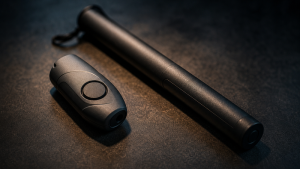
If you carry a baton, carry pepper spray. If your post allows it, consider whether a stun gun flashlight baton gives you a combined tool that expands your force options in a single piece of equipment. Some of those combo units integrate serious stopping power with utility lighting — which is genuinely useful on a patrol that takes you through poorly lit areas. That’s a practical choice, not a gimmick.
If you want to understand how professional-grade carry setups come together across different tools, the post on what security professionals actually carry for situational awareness is worth your time. It goes into how the best-prepared security pros think about their full kit — not just any single tool.
What training do you need before carrying an expandable baton for security work?
This is the question most people skip, and it’s the one that matters most. Owning a baton and being qualified to carry one professionally are two entirely different things. In most states that permit security guards to carry batons, formal baton training — often through a certified guard training program or a martial arts instructor with recognized credentials — is required before you can legally carry one on duty.
Beyond the legal requirement, there’s the practical reality: an expandable baton in the hands of someone without training is a danger to themselves and the people around them. You need to know how to draw and deploy smoothly under stress, how to use it defensively to block strikes, how to execute controlled strikes to appropriate body zones, and how to disengage safely. You need to know how to close it safely and reholster without fumbling. None of that comes naturally — it’s trained.
Find a certified instructor, take the course seriously, and drill the basics until they’re automatic. Then maintain that training with regular practice. A baton you haven’t practiced with in six months is a baton you’re not ready to carry. That’s not an opinion — that’s experience talking.
And while you’re building out your complete security kit, take a look at what else belongs in your setup. Our post on 5 things you must check before buying a self-defense baton covers the pre-purchase checklist in detail — worth reading before you finalize your decision.
Frequently Asked Questions About Choosing an Expandable Baton for Security Work
What is the best expandable baton length for a security guard?
For most security roles, a 21-inch expandable baton is the best balance of reach, manageability, and concealability. Smaller guards working confined spaces may prefer a 16-inch, while outdoor patrol officers may benefit from a 26-inch. Let your specific work environment and physical build drive the decision — not what looks most imposing on your belt.
Is steel or aluminum better for a security baton?
Steel is the better choice for professional security work. It provides greater mass for impact effectiveness and better resistance to lateral stress under use. Aluminum is lighter but more prone to deformation under real-world force. For a tool you’re counting on in a physical confrontation, steel construction — preferably forged or heat-treated — is the professional standard.
Can security guards legally carry expandable batons?
It depends entirely on your state and your specific license classification. Some states require a security guard license and separate baton permit. Others restrict batons to sworn law enforcement only. Never assume legality based on what coworkers carry. Check with your employer’s legal counsel or your state’s security licensing board before putting any baton on your duty belt.
How do you deploy an expandable baton quickly under stress?
Friction-lock batons deploy with a sharp downward flick from a drawn position. The key is muscle memory — the motion must be automatic before you ever face a real situation. Train the draw and deployment repeatedly until your hand executes it without conscious thought. Under adrenaline, fine motor skills degrade. Only deeply practiced gross motor movements stay reliable.
Should a security guard carry pepper spray in addition to a baton?
Yes, without question. A baton is a close-range tool that requires physical commitment to use. Pepper spray gives you a standoff non-lethal option before a subject gets within arm’s reach. Carrying both creates a more complete force continuum. Professional security work demands layered options — not a single tool that leaves gaps in your response capability.
What should I look for in a baton handle grip?
Look for textured rubber or aggressive knurling that maintains grip when your hand is sweating or wet. Under adrenaline, grip strength alone isn’t enough — the handle’s surface needs to do work too. A smooth or glossy handle is a liability in any real-world situation. This is not a cosmetic detail. It is a functional safety requirement.
How often should I practice with my expandable baton?
At minimum, practice draw, deployment, and basic strike patterns weekly. If your training sessions are months apart, you are not operationally ready to carry the tool professionally. Skills degrade without repetition, especially fine-motor deployment sequences. Consistent practice isn’t optional for professional carry — it’s part of the responsibility that comes with the tool.
Are combo stun gun baton tools viable for professional security use?
They can be, depending on the post and the jurisdiction. A quality stun gun flashlight baton gives you an impact tool, electrical deterrent, and utility light in a single piece of equipment. For solo patrol officers working dark environments, that multi-function capability is practically valuable. Verify the stun component is legal in your jurisdiction before carrying, and train on the entire unit — not just the baton function.
Here’s the bottom line: security work demands serious tools handled by serious people. An expandable baton earns its place on your belt only when you’ve matched it to your environment, confirmed it’s legal for your role, trained until you can deploy it automatically, and built it into a complete non-lethal kit — not relied on it as your only answer. Do all of that, and you’re carrying with real authority. Skip any of it, and you’re carrying with false confidence, which is worse than carrying nothing at all.
Take your kit seriously. Get the right tools, get the right training, and make sure everything you carry, you’re ready to use. Stay safe out there — and may you and your loved ones stay protected.