Is It Legal to Keep a Taser in Your Car? What You Must Know Before You Do
Quick Answer: In most U.S. states, yes – keeping a Taser or stun gun in your car is legal, but the rules vary significantly by state, county, and city. Some states require a permit, some restrict where the device can be positioned in the vehicle, and a handful prohibit them entirely. Before you put one in your glove box, you need to know exactly what the law says where you live and everywhere you plan to drive.
Why Does Car Carry Come With Its Own Set of Rules?
Here’s the thing – most people assume that if a stun gun or Taser is legal to own in their state, it’s automatically legal to carry anywhere, including your car. That’s not always true. Vehicle carry is treated differently than home possession in a number of states. Courts and legislatures have drawn distinctions between keeping something locked at home versus having it immediately accessible in a moving vehicle. The logic mirrors how firearms are regulated – proximity to public spaces, traffic stops, and accessibility during a potential confrontation all factor into how lawmakers view vehicle carry.
I want you to walk away from this post with a clear checklist in your head, because the last thing you need is to get pulled over for a broken taillight and end up in a much bigger conversation with an officer because you didn’t know your state’s rules. Let’s go through this carefully.
Which States Have the Strictest Laws on Taser and Stun Gun Carry?
Now look – the legal landscape shifts, so always verify with current local statutes or a licensed attorney in your area. That said, here are the categories you need to be aware of:
States That Have Historically Restricted or Banned Civilian Stun Gun Ownership
Hawaii – Has maintained restrictions on stun guns for civilian use. Verify current law before any carry.
Rhode Island – Stun guns have historically been prohibited for civilians. Confirm current statute.
Massachusetts – After a landmark 2016 Supreme Court ruling, the total ban was struck down, but local licensing requirements may still apply.
States That Allow Ownership but Restrict Carry or Require a Permit
Illinois – Allows stun guns but has local ordinances in cities like Chicago that are far more restrictive.
Michigan – Stun guns are legal, but the device cannot be concealed on your person without a CPL (Concealed Pistol License). Vehicle carry rules tie directly to this.
New York – Passed legislation in 2019 allowing civilian ownership after a court ruling, but city-level regulations – especially in New York City – remain strict.
In the majority of U.S. states, keeping a stun gun or Taser in your car is perfectly legal as long as you’re a legal adult with no felony convictions. But that majority doesn’t mean every state, and it doesn’t mean every city within a permissive state. I’m gonna tell you right now – a city ordinance can override a state law in either direction. Do your homework for your specific zip code.
What Are the Most Common Legal Restrictions on Keeping a Taser in Your Car?
Even in states where stun guns are generally permitted, there are several common restrictions that apply specifically to vehicle carry. Go through this checklist before you put a device in your car:
Age requirements – Most states set the minimum age at 18. Some set it at 21. Know which applies to you.
Felony conviction restrictions – If you have a felony conviction, you may be prohibited from possessing a stun gun in many states, even if it’s not a firearm.
Concealment rules – Some states differentiate between a stun gun that is openly accessible in your vehicle versus one that is concealed under a seat or in a locked compartment. Open storage is sometimes specifically required or specifically forbidden depending on the state.
Proximity to schools – School zones carry additional restrictions in many states. Even if you’re just in the parking lot picking up your kid, certain weapons – including electronic stun devices – may be prohibited within a defined distance of a school.
Local ordinances – As mentioned, cities and counties can add restrictions beyond the state level. Never assume the state law tells the whole story.
Cross-state travel – If you’re driving through multiple states, the laws of each state apply when you’re within its borders. What’s legal in your home state might not be legal in the state you’re passing through.
Is There a Difference Between a Taser and a Stun Gun Under the Law?
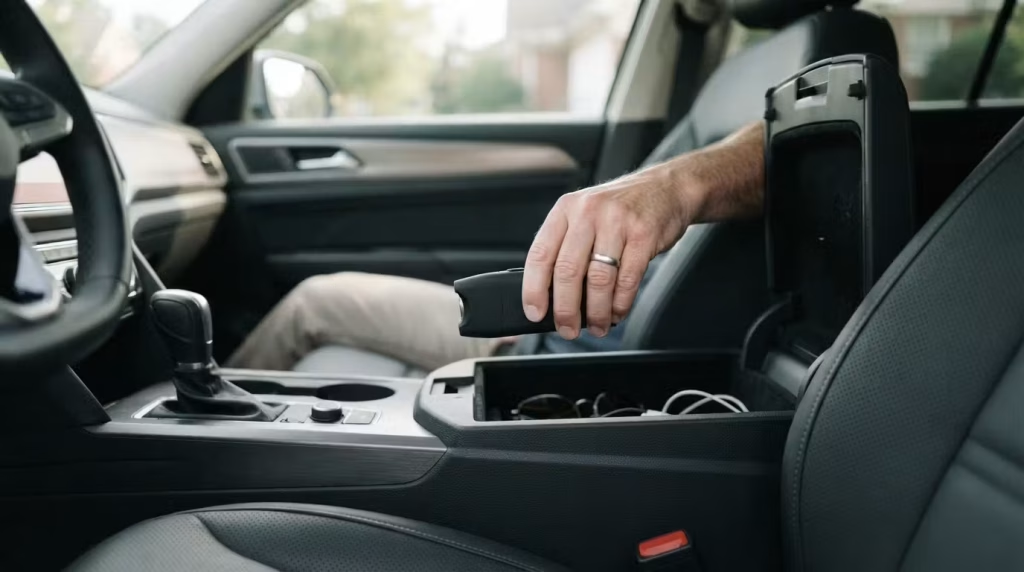
Stun Gun Inside A Car
This trips people up constantly, so let me clear it up. In everyday conversation, people use “Taser” and “stun gun” interchangeably. Legally, there can be a meaningful difference.
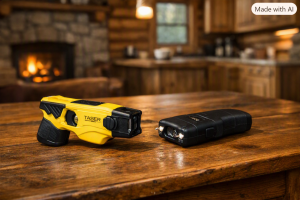
A traditional stun gun requires direct contact – you press it against an attacker and it delivers an electric shock. A Taser (technically a brand name, now used generically for projectile-style devices) fires two probes on wires that can reach an attacker from a distance, sometimes 15 feet or more. Some states regulate these differently. A few states that allow stun guns have separate – sometimes stricter – rules for devices that can project a charge at a distance, treating them more like a firearm in certain contexts.
When you’re reading your state’s statutes, look for language about electronic control devices, electronic incapacitation devices, electric stun weapons, and conducted energy weapons – all of these terms may appear in different states’ codes. Don’t assume one definition covers all devices.
What Should You Do If You Get Pulled Over and Have a Stun Gun in the Car?
This is a practical question that deserves a straight answer. If you’re pulled over and you have a stun gun or Taser in your vehicle, here’s how to handle it:
Keep your hands visible – Standard traffic stop protocol. Don’t reach for anything until asked.
Do not volunteer the information unprompted – In most states, you are not legally required to disclose a stun gun the way you might be required to disclose a firearm (check your state’s specific disclosure laws). If you’re unsure, it’s reasonable to ask an attorney before the situation arises.
If asked directly, be honest – Do not lie to law enforcement. If an officer asks whether you have any weapons, answer honestly and explain that you have a legally-owned stun gun.
Know your storage location in advance – If it’s in the glove box and you need your registration, think through that before the stop happens. Have your documents somewhere else if possible.
Keep documentation if required – In states that require a permit or license to carry, have that documentation accessible.
Honestly, the best time to think through this scenario is right now, not during a traffic stop at midnight on an unfamiliar stretch of highway.
Where in the Car Should You Store a Taser for Both Legal Compliance and Real-World Readiness?
This is where the legal question meets the practical self-defense question. And here’s the tension: the place that’s most legally safe to store a stun gun – locked in a case in the trunk – is also the least accessible in a real emergency. The place that’s most useful – in your center console or door pocket – may or may not be legally compliant depending on your state.
Work through this checklist when deciding where to store your device:
Check your state’s concealment rules first – Some states specifically address whether an electronic weapon must be in plain sight or can be stored out of view.
Consider who else is in the vehicle – If children are regularly in your car, a locked storage solution is not just a legal consideration, it’s a safety one. A stun gun that a curious 7-year-old can grab is a problem.
Think about your threat scenario – If your primary concern is a carjacking or someone approaching your parked vehicle, center console access makes sense. If your concern is road rage while driving, the equation changes.
Test your access time – Sit in the driver’s seat and practice reaching for wherever you’ve stored the device. If you can’t get to it within two or three seconds, that placement may not serve you in a real emergency.
I’m gonna be honest with you – the best self-defense tool is the one you can actually get to when it counts. Legal compliance and practical access have to work together.
Can You Keep a Taser in Your Car if You Have a Permit to Carry a Firearm?
In most states, your concealed carry permit or license covers firearms, not necessarily all weapons. A concealed carry permit does not automatically extend legal cover to a stun gun or Taser in states where those devices are separately restricted or require their own permit. Verify this for your specific state – do not assume your firearm carry permit covers all self-defense tools.
That said, in many permissive states, stun guns don’t require any permit at all, so the question doesn’t even come up. The key is knowing which category your state falls into before you make any assumptions.
No. While the majority of states permit civilian ownership and vehicle carry of stun guns, some states have restrictions or outright prohibitions. Even in permissive states, local city or county ordinances may add restrictions. Always verify the current laws for your specific state, city, and any states you plan to drive through. Laws also change, so check periodically even if you’ve researched this before.
Do I need a permit to keep a Taser in my car?
In most states, no permit is required. However, some states – and certain cities within otherwise permissive states – do require a permit, license, or registration to possess or carry an electronic stun device. Michigan’s concealed carry requirement is one example where a license affects how a stun gun may be transported. Check your local statutes directly or consult an attorney familiar with your state’s weapons laws.
Can a felon legally possess a stun gun in a vehicle?
In many states, felony convictions restrict not just firearm possession but also possession of other weapons, including stun guns and Tasers. This is not universal – some states only restrict firearms for convicted felons – but it’s a serious enough consideration that anyone with a prior felony conviction should consult with a licensed attorney before purchasing or carrying any self-defense device, including electronic weapons.
Can I drive through a school zone with a stun gun in my car?
This varies by state and sometimes by how the school zone weapons law is written. Some states’ school zone weapons prohibitions specifically include electronic stun devices. Others are written to cover only firearms. Do not assume your device is exempt. If you regularly drive near schools, look up your state’s school zone weapons statutes specifically and take note of whether electronic weapons are included in the prohibited items list.
What happens if my stun gun is found during a traffic stop in a state where it’s illegal?
Possession of a prohibited weapon – even an electronic one – can result in confiscation of the device, criminal charges, fines, and in some cases arrest. The severity depends on the state’s classification of the offense. This is exactly why verifying the laws of every state you’ll be traveling through matters, not just your home state. Ignorance of the law is not a legal defense in any jurisdiction.
Is a Taser treated differently than a stun gun under the law?
Sometimes, yes. Some states regulate projectile-style electronic weapons – devices that fire probes at a distance – more strictly than direct-contact stun guns. The reasoning is that a ranged electronic weapon has characteristics closer to a firearm than a contact-only device. When reading your state’s statutes, look for all relevant terms: electronic control device, conducted energy weapon, electric stun weapon, and similar language to ensure you’re reading the applicable rules.
Should I keep a stun gun in addition to a firearm in my vehicle?
That’s a personal decision, but many experienced carriers choose to have a stun gun as a secondary option. There are situations – proximity to schools, crossing into a state with stricter firearm rules, or scenarios where lethal force is not warranted – where a stun gun gives you a proportional response option. If you do carry both, know the legal rules for each device independently and make sure both are stored safely and accessibly.
What if I’m traveling across multiple states – do I need to research each one?
Yes, and this is non-negotiable if you’re traveling with any self-defense device. Unlike federal firearm transport laws that provide some uniform guidance, stun gun laws are entirely state-controlled and vary dramatically. Map your route, identify which states you’ll physically enter, and look up each one’s laws on electronic weapons. When in doubt, secure the device in a locked case for the portion of the trip where legality is uncertain.
The Bottom Line: Know Before You Carry
Here’s the thing – having a stun gun in your car can be a smart, practical self-defense choice. It gives you a non-lethal option. It can stop a threat long enough for you to get away. It doesn’t require the same level of training commitment as a firearm to use effectively. For a lot of people – especially those who don’t carry a gun – it fills a real gap in their protection plan.
But none of that matters if you’re breaking the law by carrying it. A legal mistake can turn a self-defense tool into a criminal charge, and that outcome helps nobody. So before you buy, before you load it in the console, run through this checklist one more time:
Is your state on the restricted or prohibited list?
Does your city or county have ordinances beyond state law?
Does your state treat the specific device you have – contact stun gun versus projectile Taser – differently under the law?
Are there age or felony restrictions that apply to you?
Will you be crossing into any other states, and have you checked those laws too?
Is your storage location legally compliant and practically accessible?
You don’t have to carry a gun, but carry something – and carry it smart. Do the legal homework once, store the device wisely, and go about your day knowing you’re both protected and compliant. That’s the goal.
With over 25 years in the Self Defense Industry, Jose Diaz has provided lots of advise to those seeking to protect themselves against danger. Jose is a hard working individual who has use his skills to address the many faults of self protection in our society. As a father, Grandfather and a Great grandfather he wants to keep his family safe. This is why he has created his business, "Brainstorm Security Shop". He wants to provide people with a choice to defend themselves in case of a personal attack. His self-defense gadgets, like stun guns, pepper sprays, knifes, personal alarms and others will provide protection against any attacker. Please take a look at his products since very well can save your life in case of a personal attack. May you and your loved ones be safe and enjoy a long and prosperous life.