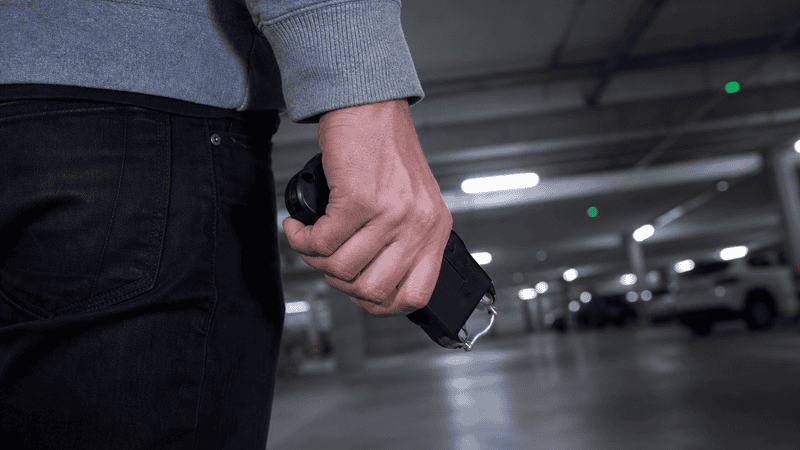
A stun gun delivers a high-voltage, low-amperage electrical shock that causes immediate involuntary muscle contractions, intense localized pain, disorientation, and temporary loss of muscle control. The effect lasts several seconds after contact is broken and is not permanently harmful to a healthy person — but it is deeply unpleasant, disorienting, and effective at stopping a threat long enough for you to get away.
Now look — I’ve been in this industry for over 25 years, and that question comes up more than almost any other. People want to know what they’re actually carrying. What it actually does. And I respect that. You should know exactly what a tool does before you put it in your pocket or your purse. That’s not curiosity — that’s responsibility. So let’s break it down, piece by piece, no sugarcoating.
What physical effects does a stun gun actually cause in the body?
Here’s the thing — a stun gun doesn’t just sting. The moment those probes make contact with a person’s body, the electrical charge interrupts the normal communication between the brain and the muscles. Your nervous system works on electrical signals, and a stun gun essentially overwhelms those signals with noise. The result is that the muscles in the affected area contract rapidly and involuntarily — and they don’t stop until the device is removed.
Most people describe it as an intense, burning pain that radiates from the contact point. It’s not like touching a doorknob after walking on carpet. It’s deeper than that. The muscles lock up. If the contact is on the torso, the person’s core muscles can seize, causing them to lose balance or drop to the ground. There’s often a confused, dazed sensation immediately after — disorientation that makes it hard to think clearly, let alone continue an aggressive action.
The localized area where the probes make contact will often feel sore afterward — sometimes for hours. Some people report a residual muscle ache similar to a hard cramp. That fades. There is no lasting neurological damage from a properly functioning stun gun used in a standard encounter. But in the moment? It commands complete attention. That’s exactly what it’s designed to do.
Does a stun gun affect the heart or cause permanent injury?
I’m gonna tell you right now — this is the question people are afraid to ask but absolutely need to. The short answer is: standard handheld stun guns, used as directed, are not designed to affect the heart and pose an extremely low risk of permanent injury in healthy individuals. The amperage in consumer stun guns is kept well below the threshold that would disrupt cardiac function. Voltage gets headlines, but amperage is what matters when it comes to lethality — and consumer stun guns are engineered to stay non-lethal.
That said, this is not something to be careless about. People with pre-existing heart conditions, pacemakers, or other serious medical vulnerabilities face a different risk profile. Children, the elderly, and anyone with compromised health should never be on the receiving end of a stun gun. This is a self-defense tool designed for use in a genuine threat situation — not a toy, not a prank device, not something to test on your buddy at a barbecue. I’ll say that plainly every time the subject comes up.
The legal and ethical responsibility of carrying a stun gun includes understanding who it should and should not be used against. If you’re going to carry one, carry it with that awareness locked in. Before you decide what to carry, it’s also worth checking out our post on stun gun laws by state for 2026 — because legality varies, and knowing your local rules is part of carrying responsibly.
How long does the effect of a stun gun last after contact?
Most people recover full muscle control within five to fifteen minutes, depending on the duration of contact and the individual’s physical condition. A one-second burst causes sharp pain and muscle disruption. A three-to-five second contact — which is what most self-defense training recommends in an actual threat situation — causes more significant muscular interference and a longer period of disorientation.
Here’s what that means in practical terms: a stun gun is not meant to incapacitate someone indefinitely. It buys you a window. A window to run, to get to your car, to get to a safe space, to call for help. That’s it. If you’re thinking of a stun gun as a device that will neutralize someone for an hour, you’re thinking about it wrong — and that misconception could cost you in a real situation.
That window is real and it’s valuable. But you have to use it. The moment you deploy a stun gun, your next move should already be in motion. This is why I always say: carrying a tool is only half of it. Knowing what you’ll do next is the other half. Stun guns are most effective when they’re part of a plan, not a last resort with no follow-through.
Does a stun gun work through clothing?
Yes — but with important caveats you need to understand before you rely on it. A stun gun can deliver a shock through one or even two layers of standard clothing, particularly thinner fabrics. Heavy materials like thick denim, leather jackets, or layered winter coats significantly reduce effectiveness. The probes need to get the electrical current close enough to the body to do their job, and dense fabric creates distance that weakens the discharge.
This is a real-world variable that most product descriptions don’t talk about enough. If someone is wearing a heavy coat in the middle of winter, your contact point matters more than ever. Exposed skin or thinner fabric areas — the neck, the forearm, the back of the hand — are going to produce a more reliable effect than trying to drive through a thick jacket. When you’re thinking through your self-defense plan, think about the seasons, too.
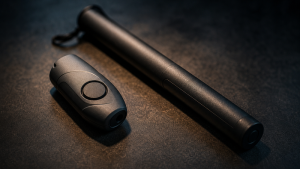
This is also why choosing the right stun gun for your situation matters. A higher-voltage device can push through thicker material more reliably. And a device with a longer reach — like a rechargeable stun gun flashlight baton — gives you the option to make contact at a safer distance rather than having to get in close. That distance matters when the threat is large and you’re not.
What does it feel like to use a stun gun on an attacker — for the person deploying it?
People don’t ask this one enough, and they should. Here’s the truth: you will feel it too, slightly, if the circuit completes back through your hand. That tingling sensation is low-level and not harmful, but it catches first-time users off guard. More importantly, the psychological experience of deploying a stun gun under stress is significant. Adrenaline is already flooding your system. Your hands may be shaking. Your vision narrows.
This is why training matters. Not elaborate tactical training — just familiarity. Know how to activate your device without looking at it. Know where the safety is. Know how to hold it so you don’t accidentally touch the probes. Practicing those basic actions in a low-stakes environment means your hands know what to do when your brain is overwhelmed by stress. That muscle memory is worth more than the highest-voltage device on the market.
If you’re a mom, a college student, a commuter, a shift worker — anyone who spends time moving through the world alone — I’d point you toward options built with ease of use in mind. Check out our stun guns designed for moms — simple activation, compact size, and options that fit real life. For those who want a combination of tools in one, our stun guns with flashlights give you visibility and deterrence together, which is often more practical than a standalone device.
Is the sound of a stun gun discharging part of how it works?
Absolutely — and this one surprises people. That sharp, electric crackling sound when you test-fire a stun gun in the air is not a side effect. It’s a feature. A genuine deterrent. I’ve seen situations described by customers where just activating the device — not even making contact — caused an aggressive person to back off immediately. The sound is unmistakable, it’s aggressive, and it signals without any ambiguity that you are not the easy target they were looking for.
This matters at night, in a parking lot, in a stairwell, anywhere that a verbal warning alone might not carry weight. The crack of a stun gun is a language anyone understands. Many modern devices are also built with an additional alarm component — a loud piecing tone that adds an audible cry for help to the deterrent package. If that combination interests you, our post on stun guns with loud sound for instant threat control goes deeper on that topic.
For those who want protection that’s always at hand and easy to carry, a stun gun with a carrying case keeps the device protected and accessible without digging through a bag. The tools that get used are the ones you can reach.
Frequently Asked Questions About What a Stun Gun Feels Like
Does getting hit by a stun gun hurt?
Yes, significantly. The immediate sensation is intense burning pain at the contact point combined with involuntary muscle contractions. Most people describe it as overwhelming and disorienting. The pain is sharp and localized, and the muscle effects can cause a person to lose their balance or fall. The discomfort typically fades within minutes, but the experience is serious enough to stop most attackers in their tracks.
Can a stun gun knock someone unconscious?
A handheld consumer stun gun is unlikely to render someone unconscious on its own. It causes pain, muscle disruption, and disorientation — which may cause someone to fall or drop to the ground — but it is not designed to knock someone out. Its purpose is to create a window of time for you to escape, not to incapacitate someone indefinitely. Treat it as a distraction tool, not a knockout device.
Will a stun gun stop someone who is very large or on drugs?
This is a real concern. A stun gun’s effectiveness can be reduced against someone with a very high pain tolerance, or someone significantly impaired by drugs or alcohol. The neurological disruption still occurs, but a person in an altered state may not respond predictably to pain. Aim for areas where muscle disruption matters most — the torso, the neck, the hips — rather than relying on pain response alone.
How long does the pain from a stun gun last after it’s removed?
Acute pain at the contact point typically subsides within minutes. Mild muscle soreness or a residual aching sensation at the contact area can persist for a few hours, similar to a hard muscle cramp. Most people feel close to normal within fifteen to thirty minutes. There is no lasting nerve damage or permanent injury expected from a standard consumer stun gun used in a brief self-defense encounter.
Is it dangerous to stun someone multiple times?
Repeated or prolonged exposure increases risk. A single short burst for self-defense is designed to be non-lethal. Extended contact or multiple rapid applications push beyond the intended use of the device. As a self-defense tool, you deploy it to create an escape window — not to continue applying it. Use it, move, and get to safety. Extended use moves outside the non-lethal design parameters and raises both ethical and legal concerns.
Can I feel the shock through the handle when I use a stun gun?
You may feel a mild tingling in your hand if the electrical circuit partially completes back through the grip — this is common and not harmful. Well-designed stun guns have insulated handles that prevent the user from receiving a meaningful shock. That said, first-time users often notice a slight buzzing sensation in the hand. Familiarizing yourself with your device before you need it removes the element of surprise when it counts.
Does a stun gun work the same on everyone?
No. Individual response varies based on body size, pain tolerance, physical condition, and whether the person is impaired by substances. Contact location also matters — areas with less clothing coverage and more muscle mass produce stronger effects. Most healthy adults will respond clearly to a stun gun, but it should never be assumed to be 100% effective against every individual in every circumstance. Situational awareness and an exit plan remain critical.
Is it legal to carry a stun gun where I live?
Stun gun laws vary significantly by state and sometimes by city or county. Most U.S. states permit civilian carry of stun guns with few or no restrictions, but some states have specific rules about who can carry, where carry is permitted, and what voltage is legal. Before you purchase or carry a stun gun, review the current laws for your location. Our detailed guide on stun gun laws by state is a good starting point.
I’ll close the way I always do when this topic comes up: knowing what your tool does — really understanding it — is what separates someone who’s prepared from someone who’s just armed. A stun gun is a serious piece of self-defense equipment. It delivers a real, significant physical effect. It has limitations. It requires you to have a plan for what comes next. If you’ve got all of that dialed in, it’s one of the most practical tools an everyday person can carry.
You don’t have to carry a gun. But carry something — and understand it. Browse our full selection at Brainstorm Security Shop and find the option that fits your life, your routine, and your comfort level. May you and your loved ones stay protected.