Can I use pepper spray to defend myself inside a retail store?
Yes, you can legally use pepper spray to defend yourself inside a retail store — as long as you have a reasonable belief that you face an immediate threat of bodily harm and your state permits civilian carry of pepper spray. The same self-defense laws that apply on the street generally follow you indoors, whether you’re in a grocery store, a mall, or anywhere else. That said, there are important legal, practical, and situational factors you need to understand before you ever reach for that canister.
Is it legal to carry pepper spray inside a store?
In most U.S. states, yes — carrying pepper spray in a retail environment is perfectly legal for adults who meet their state’s requirements. Pepper spray is a defensive tool, not a weapon in the traditional sense, and the overwhelming majority of states allow civilians to carry it. Some states set restrictions on canister size, concentration of the active ingredient (OC — oleoresin capsicum), or the age of the carrier, but outright bans are rare.
Here’s the thing, though — individual stores can set their own policies. A private retailer has the legal right to post “no weapons” policies that could technically include defensive sprays. You won’t find that rule posted at most grocery stores, but it does come up at certain venues. If you see a posted policy, know what it says. That’s your responsibility as someone who carries. When in doubt, keep it concealed and be aware of local ordinances, especially in cities like New York or Chicago that have their own rules layered on top of state law.
Always check your state’s specific statutes. I’ve been in this industry for over 25 years and I’ll tell you right now — the law is never a reason not to be prepared, but it is always something you need to know cold before you carry anything.
What counts as legal self-defense when using pepper spray indoors?
The legal standard is the same indoors as it is anywhere else: you must have a reasonable belief that you were in imminent danger of being harmed, and your response must be proportionate to that threat. Spraying someone because they bumped into you or raised their voice is not legal self-defense — that’s assault. Spraying someone who is actively threatening you, grabbing you, or attacking you is a different matter entirely.
Courts look at a few key factors: Did the threat appear immediate? Did you have a reasonable opportunity to retreat, and if so, does your state require it? Was the force you used proportionate? Most states have adopted some form of “stand your ground” or at minimum a “castle doctrine” that gives you the right to defend yourself without retreating. But not all states are the same — some still require retreat if you can do so safely. Know where your state stands on this before you carry anything.
Now look — I’m not an attorney, and nothing I say here is legal advice. What I am is someone who has spent decades helping everyday people think through these scenarios clearly. If you carry, study your state’s self-defense laws the same way you study your tool. Knowledge is part of the kit.
Are there risks to using pepper spray in an enclosed indoor space?
Yes, and this is something I want to be completely honest about — because it matters. Pepper spray in an open outdoor environment dissipates quickly. Inside a retail store, you’re dealing with limited airflow, and the spray can linger in the air. That means bystanders — including children, elderly shoppers, and people with respiratory conditions like asthma — can be affected even if they’re nowhere near the threat.
This doesn’t mean you shouldn’t use it if your life is on the line. It means you need to understand the trade-offs. If someone is attacking you inside a store, defending yourself is still the priority. But ideally, your situational awareness kicks in before it escalates that far. The goal is always to avoid the confrontation if possible, de-escalate if confronted, and deploy your tool only when there is no other reasonable option.
There’s also the question of blowback. In an indoor, enclosed space with HVAC airflow, a portion of that spray can come back toward you. Gel formulas reduce this risk significantly compared to stream or fog delivery systems. A gel or stream pattern gives you more directional control and less ambient contamination. If you’re thinking about what to carry inside buildings frequently, a gel formula is worth a serious look.
What type of pepper spray is best suited for indoor self-defense?
For indoor use, a gel or stream formula is your best option. Here’s why: gel sticks to the attacker’s face and doesn’t atomize into a fine mist that hangs in the air. A stream delivery gives you directional accuracy without the wide dispersal of a cone or fog spray. Both reduce the risk of affecting bystanders or bouncing back toward you in a closed environment.
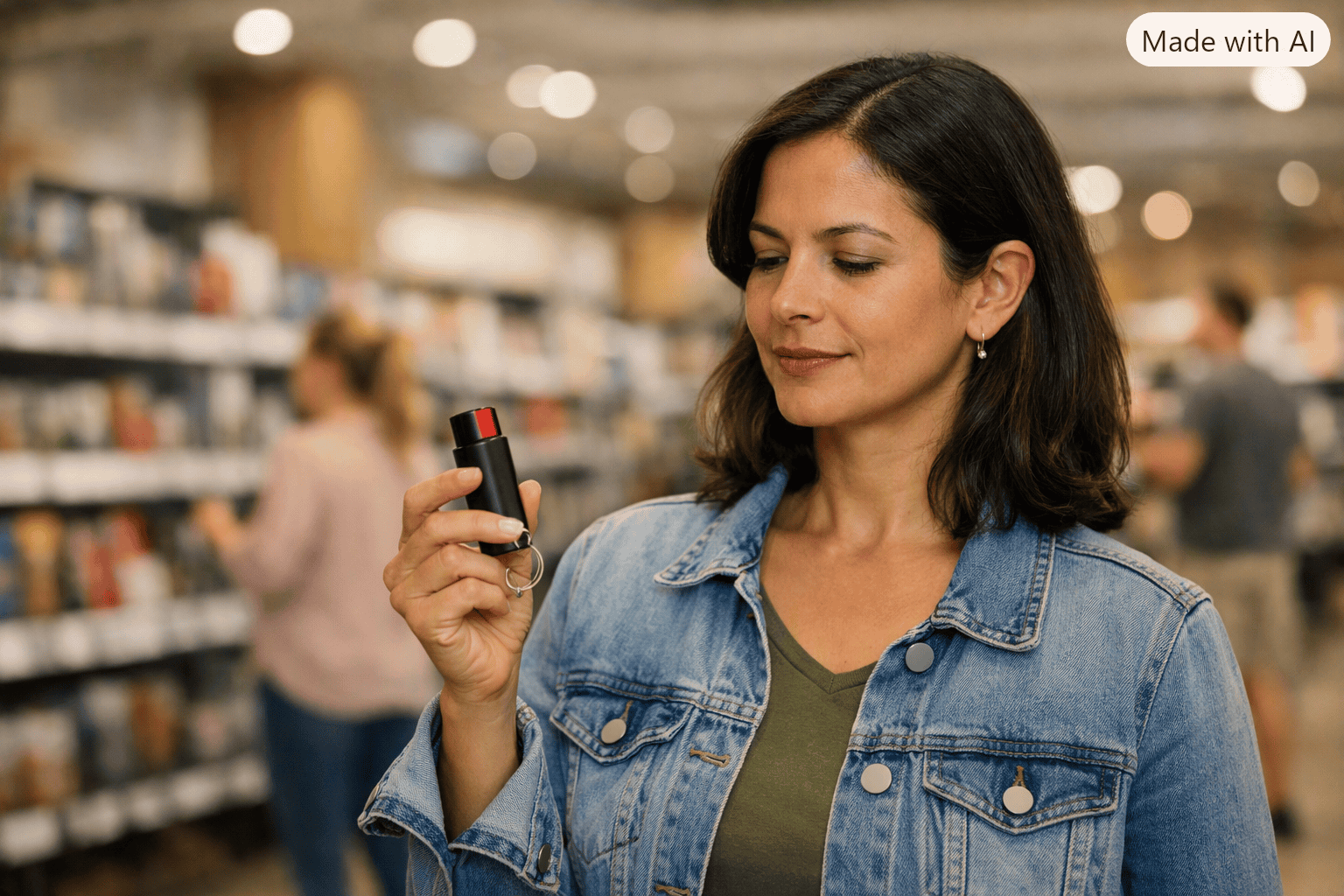
You also want something compact enough to carry daily without it being a burden. A keychain-size canister fits easily in a hand, a pocket, or a purse, and it puts the tool within reach at a moment’s notice. What I always tell people is this — the best pepper spray is the one you actually have with you. A large, high-capacity canister that’s sitting in your car does you no good when something happens at aisle seven.
Look for a formula with at least 1% to 2% Major Capsaicinoids (MC) — that’s the active burn component, and it’s a more reliable measure of stopping power than Scoville Heat Units alone. Some products list SHU ratings that sound impressive but have low MC percentages. Focus on MC content, delivery type, and whether the safety mechanism is easy to disengage under stress.
How should I carry pepper spray so it’s actually accessible in an emergency?
Accessibility is everything. A defensive tool buried at the bottom of a bag is not a defensive tool — it’s a hope. The whole point of carrying is that you can deploy it within seconds, ideally with one hand, even when your adrenaline is through the roof and your fine motor skills are taking a hit.
I always recommend a dedicated pocket or a keychain carry. If you’re a woman carrying a purse, get a small pepper spray with a clip that attaches to the inside of the bag at the top — you can find it instantly without digging. Men often do well with a front pocket or belt clip option. Whatever your method, practice reaching for it. Seriously — practice it dry, at home, without any pressure. Muscle memory is built in training, not in the moment of crisis.
Also make sure you know which direction the nozzle faces when you grab it. You don’t want to spray yourself. Most quality canisters have a tactile indicator or a finger groove so you can orient it correctly without looking. Test your grip before you need it for real.
What should I do after using pepper spray in self-defense?
Call 911 immediately. Report what happened, identify yourself as the victim, and tell them you used pepper spray in self-defense. Do not leave the scene unless you need to get to safety — leaving can complicate the legal picture. Cooperate with responding officers, give them a clear account of the threat you faced, and contact an attorney as soon as reasonably possible.
Document everything you can: the layout of where it happened, witnesses present, any surveillance cameras in the area, and the exact sequence of events while it’s fresh. Your account of the threat, your actions, and your intent to defend yourself will matter if the situation leads to any legal proceedings. Being prepared to explain your decision clearly and calmly is part of responsible carry.
Store owners and mall security may also respond. Stay calm, be cooperative, and do not be aggressive. You were the victim acting in defense — carry yourself that way from the first moment responders arrive.
Yes, private property owners can set their own rules, and that includes prohibiting defensive sprays. However, enforcement is typically limited to asking you to leave if they discover you’re carrying. In most cases, retail stores don’t actively enforce this, and most don’t post such restrictions. Always be aware of any posted policies, especially in certain venues or jurisdictions with stricter local regulations.
Will I get in legal trouble for using pepper spray on someone in a store?
Not if your use was legally justified. Self-defense laws protect you when you face an imminent, credible threat and respond proportionately. If the use of force was reasonable under the circumstances, criminal charges are unlikely. That said, you may face civil action from the other party regardless of outcome. This is exactly why knowing your state’s self-defense statutes and consulting an attorney afterward is always smart practice.
Does pepper spray work on people who are under the influence of drugs or alcohol?
It can be less effective on individuals who are heavily intoxicated or on certain substances like PCP or methamphetamine, which can reduce pain perception. OC spray still causes involuntary eye closure and inflammation of the mucous membranes, which can impair the attacker’s ability to function even if they don’t feel the burn. It’s not a guaranteed stopper in every case, which is why situational awareness and the ability to create distance remain critical.
What’s the difference between OC spray, Mace, and tear gas?
OC (oleoresin capsicum) is derived from hot peppers and causes an immediate inflammatory reaction — burning, involuntary eye closure, coughing, and disorientation. Traditional Mace was a tear gas compound (CN), but most modern Mace-brand products now use OC or a combination. Tear gas (CS) is primarily used by law enforcement in crowd control. For civilian self-defense, OC-based pepper spray is the most widely available, legally permitted, and effective option.
How close do I need to be for pepper spray to be effective?
Most defensive pepper spray canisters have an effective range of six to twelve feet, depending on the delivery type. Stream and gel formulas are more accurate at longer range but require better aim. Cone or fog sprays cover a wider area but drop off in intensity at distance and disperse more broadly — not ideal indoors. For typical retail store confrontations, you’ll likely be within effective range if you can deploy before contact is made.
Can pepper spray cause permanent damage to the person I spray?
When used correctly and in standard civilian concentrations, pepper spray does not cause permanent injury. The effects — intense burning, eye closure, difficulty breathing — are temporary and typically subside within 30 to 45 minutes with fresh air and water flushing. There are rare cases of complications in individuals with severe respiratory conditions, which is another reason indoor use requires careful consideration. The goal of any defensive tool is to stop a threat, not cause lasting harm.
Should I tell the store employees or security what happened right away?
Yes, absolutely. Notify store security or employees as quickly as possible after using pepper spray in self-defense. They will need to respond to the situation, assist affected individuals, and likely contact law enforcement. Being upfront and cooperative from the start establishes your credibility as the victim. It also ensures that bystanders who may have been inadvertently exposed can receive assistance promptly. Transparency from the beginning works in your favor.
Is a keychain pepper spray strong enough to actually stop an attacker?
Yes, when it contains a quality OC formula with adequate Major Capsaicinoid content. Don’t let the small size fool you — a well-formulated compact canister delivers the same active compound as a larger one. What matters is the MC percentage and the delivery system, not the canister’s physical size. Keychain models are designed for close-range defensive use and are entirely capable of stopping an aggressive threat when properly deployed.
Here’s the bottom line: pepper spray is one of the most practical, accessible, and effective defensive tools available — and yes, it can absolutely be used to defend yourself inside a retail store when the situation demands it. The key is knowing your state’s laws, choosing the right formula for enclosed environments, carrying it where you can actually reach it, and understanding the full picture of what responsible carry looks like. You don’t have to carry a gun. But carry something — and know how to use it. Stay safe out there.
With over 25 years in the Self Defense Industry, Jose Diaz has provided lots of advise to those seeking to protect themselves against danger. Jose is a hard working individual who has use his skills to address the many faults of self protection in our society. As a father, Grandfather and a Great grandfather he wants to keep his family safe. This is why he has created his business, "Brainstorm Security Shop". He wants to provide people with a choice to defend themselves in case of a personal attack. His self-defense gadgets, like stun guns, pepper sprays, knifes, personal alarms and others will provide protection against any attacker. Please take a look at his products since very well can save your life in case of a personal attack. May you and your loved ones be safe and enjoy a long and prosperous life.