An expandable baton — also called a collapsible or telescopic baton — is a compact, concealable impact tool that extends to full length with a flick of the wrist. A nightstick is a fixed-length baton, traditionally made of wood or hard polymer, that carries no collapsing mechanism at all. The expandable baton wins on portability and concealment. The nightstick wins on simplicity and raw striking mass. Those two differences drive every decision a person should make when choosing between them.
Now look — most people asking this question aren’t asking out of curiosity. They’re trying to figure out what they should actually carry or keep on hand. That’s the right reason to ask, and I’m going to give you a straight answer. Twenty-five years in this industry has taught me that knowing your tool is just as important as having one. Let’s get into it.
What makes an expandable baton different from a traditional nightstick in design and function?
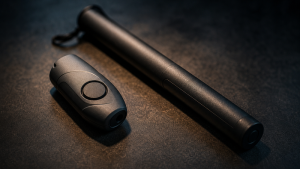
The expandable baton — often referred to as an ASP-style or telescopic baton — is built around one core principle: go from small to formidable in under a second. Most models collapse down to eight to twelve inches and extend out to sixteen to twenty-six inches with a sharp downward snap of the wrist. They’re typically made from steel, aluminum, or reinforced alloy, and the tip carries most of the striking weight. That concentrated mass at the end is what gives them real stopping power despite the slim profile.
A nightstick is a different animal entirely. It’s a fixed-length baton — usually twenty-one to twenty-six inches — that doesn’t collapse, doesn’t extend, and has no moving parts. The classic nightstick has a side handle that allows the carrier to use it for both strikes and blocks. Older designs were made from hardwood like hickory. Modern versions use polycarbonate, rubber, or reinforced polymer. They’re heavier through the shaft, which gives them a different kind of impact energy — more distributed force rather than the concentrated tip strike you get from a telescopic baton.
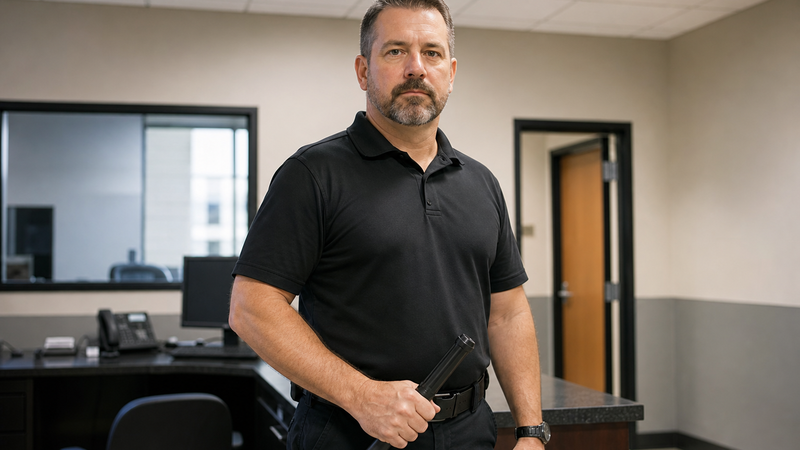
Here’s the thing — neither one is universally better. They were designed for different roles. The nightstick was built for professionals who carry it openly, in a holster, during a full shift. The expandable baton was designed for plainclothes officers, security personnel, and civilians who need something that can disappear into a pocket or bag when not in use. Purpose shapes design. Design determines how you carry and use it.
Which one is easier to deploy in a real self-defense situation?
The expandable baton is faster from concealment — period. If it’s clipped to your belt or sitting in your jacket pocket, you can draw it and deploy it with one hand in a single fluid motion. That matters when you’re startled, when your adrenaline is spiking, and when your fine motor skills are starting to suffer. One hard snap and you’ve got reach and a serious deterrent in your hand.
The nightstick is already at full length, which means there’s no deployment step — but there’s also no concealment. You’re either carrying it openly or you’re not carrying it at all. For uniformed security guards, that’s not a problem. For a civilian walking through a parking garage or sitting in their car, a twenty-four-inch fixed baton is a completely impractical carry option.
I’m gonna tell you right now — for civilian carry and non-professional use, the expandable baton has a decisive practical advantage. The best self-defense tool is the one you actually have with you when you need it. A nightstick you left in your vehicle because it was awkward to carry is useless. An expandable baton you have clipped to your belt because it fits there without thinking — that’s the one that does the job.
If you’re looking at purpose-built options that combine impact capability with other tools, take a look at our stun gun baton with rechargeable flashlight — a modern take that layers multiple defensive capabilities into a single carry item.
How do expandable batons and nightsticks compare in terms of legal carry restrictions?
This is where things get serious, and where I have to be completely straight with you. Both expandable batons and nightsticks are regulated — and in some states, they’re outright prohibited for civilian carry. The legal landscape varies dramatically from state to state and even city to city. California, for instance, bans expandable batons for civilian possession entirely. Other states allow open carry but restrict concealed carry. Some jurisdictions require no permit at all.
I won’t give you specific legal advice — that’s not my lane, and the laws change. What I will tell you is this: before you buy either one, check your local and state laws. Don’t assume it’s legal because you saw it for sale online. Retailers can sell to states where the buyer bears the legal responsibility. That burden is on you, and ignorance of the law is not a defense.
What I can tell you from experience is that expandable batons tend to draw more regulatory attention because of their concealment capability. Nightsticks, being openly carried, are often treated differently under the law — but that doesn’t mean they’re universally permissible either. Know your jurisdiction before you make any purchase decision. This is not optional.
Which type of baton is better suited for security professionals versus everyday civilians?
Security professionals working in uniform — at a venue, a retail site, a parking facility — benefit from the nightstick’s presence and versatility. It’s visible, which serves a deterrent function. The side handle allows for control holds and blocking techniques that the straight collapsible baton doesn’t replicate as well. Many security training programs are built around the traditional nightstick or PR-24 style baton specifically. If you’re working in a professional security role with proper training, the nightstick belongs in that conversation.
For civilians — someone walking to their car, a college student on campus at night, a woman commuting alone, a delivery driver running routes in rough areas — the expandable baton makes far more sense as a carry option. It fits in a jacket, a bag, a glove compartment. It’s not intimidating to bystanders when it’s collapsed. And it can be deployed in a fraction of a second when things go wrong.
If you’re a security professional who wants the expandable form factor combined with additional stopping power, our stun gun flashlight baton gives you that combination — extending baton reach with an integrated electrical deterrent and tactical light. That’s a serious tool for a serious role.
Does an expandable baton require training to use effectively?
Yes. And I don’t care what anyone else tells you — owning a baton without any training is how you end up making the situation worse. This applies to expandable batons and nightsticks equally, but especially to the expandable baton because the deployment itself requires muscle memory under stress. If you’ve never practiced the snap extension, your first time doing it in a real situation is not going to go well.
Basic baton training teaches you deployment, target areas, striking angles, and — critically — when not to strike. The legal threshold for using an impact weapon is serious. You need to understand what justifies its use, how to position yourself before deploying, and how to control a situation without escalating it unnecessarily. This isn’t complicated training, but it’s training you have to do. Watch instructional video, take a class if one is available in your area, and practice the draw and deployment repeatedly until it’s automatic.
The baton is a force multiplier. Used correctly, it buys you distance and gives you a decisive advantage over someone who’s unarmed and aggressive. Used incorrectly, it creates legal liability and physical risk. Take the ten hours, do the training. It’s worth every minute.
For more guidance on picking the right baton for your situation and skill level, read our post on how to choose the right expandable baton for security work — it covers the practical factors in detail.
What materials are expandable batons and nightsticks made from, and does it matter?
It matters more than most people think. Expandable batons are typically constructed from one of three materials: steel, aircraft-grade aluminum, or a reinforced alloy. Steel is the heaviest and most durable — it delivers more impact force but adds carry weight. Aluminum is lighter and still plenty strong for civilian defensive use. Cheap alloy or zinc-based construction is where you want to be careful — a baton that bends or fails under real stress is a liability, not an asset.
Nightsticks have traditionally been hardwood — hickory was the gold standard for decades because it absorbs impact shock while delivering serious striking force. Modern nightsticks have largely shifted to polycarbonate and dense polymer composites. These materials are weatherproof, lighter than wood, and don’t crack under cold or dry conditions the way hardwood can over time. High-quality polymer nightsticks perform comparably to hardwood in most defensive scenarios.
The grip surface matters too. An expandable baton with a knurled or rubberized handle gives you purchase even with wet or sweaty hands — that’s a non-negotiable feature in my book. A smooth handle under stress is a baton you could drop at the worst possible moment. Don’t buy based on price alone. Buy based on construction quality and what the tool will actually have to do.
If you want to see how modern manufacturing has combined baton capability with integrated lighting and electrical deterrents, browse our rechargeable stun gun flashlight baton — built for real-world carry with serious materials.
Frequently Asked Questions About Expandable Batons and Nightsticks
Can civilians legally own an expandable baton?
In many states, yes — but not all. States like California prohibit civilian possession of expandable batons outright. Others allow ownership and open carry but restrict concealed carry. Some states have no restrictions at all. Before purchasing any baton, check your specific state and local ordinances. The law varies significantly, and you are responsible for knowing what applies where you live and carry.
Is an expandable baton more dangerous than a nightstick?
Not inherently — but the expandable baton’s concentrated tip strike delivers a different kind of impact than the distributed force of a nightstick. Both are serious impact weapons capable of causing significant injury. The danger level depends on how, where, and with how much force either weapon is used. Neither should be treated casually. Both require responsible ownership and at least basic training in proper use and legal application.
How long does an expandable baton extend to?
Most civilian and security-grade expandable batons extend to sixteen, twenty-one, or twenty-six inches depending on the model. Collapsed lengths typically range from eight to thirteen inches. The right extended length depends on your build, your carry purpose, and what feels controllable in your hand. Longer reach means more distance from an attacker, but a longer baton is also harder to control in tight spaces. Match length to your realistic use case.
What is the best way to carry an expandable baton?
A belt clip or dedicated baton holster is the most reliable carry method. It keeps the baton accessible, protects it from damage, and allows a consistent draw every time. Some people carry expandable batons in jacket pockets — that works for shorter models. Throwing it loose in a bag is the worst option because retrieval under stress is slow and unreliable. Consistent placement matters. Your carry position should be the same every time so your hand goes there automatically.
Can a nightstick be used for blocking as well as striking?
Yes — and this is one of the nightstick’s genuine advantages over the straight expandable baton. The traditional side-handle nightstick, or PR-24, was specifically designed to allow forearm blocking techniques as well as offensive strikes. The handle perpendicular to the shaft lets you brace the baton against your forearm to deflect incoming strikes. This blocking capability is part of why many security and law enforcement training programs favor the nightstick for personnel who need both offensive and defensive options.
Which baton is better for someone with no prior training?
Neither baton is ideal without training — that’s the honest answer. That said, if someone is starting from zero and their primary need is a deterrent, an expandable baton with basic deployment practice is the more practical starting point. Its compact size makes it a realistic carry option, and the extension itself can serve as a deterrent before a strike ever happens. Pair it with even minimal instructional video training on targeting and deployment, and you’ve made a real improvement in your preparedness.
Are there legal alternatives to batons that don’t carry the same restrictions?
Yes, and this is worth knowing. Pepper spray, personal alarms, and stun devices are far less regulated in most states and can be carried legally by civilians in places where batons are restricted. If you’re in a state that limits baton carry, a high-strength pepper spray or a stun gun flashlight baton gives you a strong defensive option without the legal complexity. Many people carry a layered combination — multiple tools for different distances and scenarios. You don’t have to limit yourself to one option.
How long should a telescopic baton be for self-defense carry?
For most civilians, a twenty-one-inch extended length hits the right balance between reach and manageability. It gives you enough distance to keep an attacker at bay without being unwieldy in close quarters. Shorter models at sixteen inches are easier to carry but sacrifice reach. The twenty-six-inch models are better suited to security professionals who train regularly with them. For a deeper breakdown of length selection, read our post on how long a telescopic baton should be for self-defense.
The difference between an expandable baton and a nightstick comes down to this: one is built for open professional carry with maximum versatility, and the other is built to go with you everywhere without drawing attention — and be ready in a fraction of a second when you need it. Both are serious tools. Both deserve serious handling. Know what you’re carrying, know why you’re carrying it, and put in the time to use it right.
At Brainstorm Security Shop, we carry options across the spectrum — from compact baton-style stun devices to full tactical tools built for professionals. Browse what we have, pick what fits your life, and make the decision once so you never have to make a desperate one. Stay safe out there.