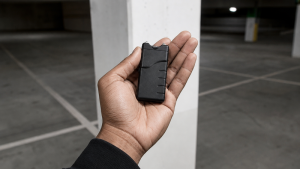
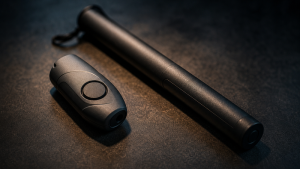
A personal alarm needs to be at least 120 decibels to be effective at scaring off an attacker — and honestly, 130dB is where you really want to be. At that volume, the sound is physically jarring, disorienting to anyone standing close, and loud enough to carry across a parking lot, down a hallway, or through a wall to reach someone who can help. That’s not a marketing number. That’s the threshold where noise stops being a nuisance and starts being a weapon.
I’ve been in this industry for over 25 years, and I’ll tell you — the question I hear most often isn’t about stun guns or pepper spray. It’s about personal alarms. And I get it. A lot of people aren’t ready to carry a weapon, but they still want something in their hand when the situation goes wrong. That instinct is right. A personal alarm is one of the smartest, simplest tools you can carry. But it’s only going to do its job if it’s loud enough to matter. Let me walk you through exactly what you need to know, because this is too important to get wrong.
Why does decibel level matter so much in a personal alarm?
Decibels aren’t linear — they’re exponential. A 120dB alarm isn’t twice as loud as a 60dB alarm. It’s roughly a million times more intense. That matters in a crisis because you need sound that does two things simultaneously: disorients the person threatening you and signals everyone nearby that something is wrong. A quiet alarm does neither.
Think about the scenarios I think through every time someone asks me about these. A woman leaving her office at 10 PM. A college kid walking back from the library. A grandmother getting to her car after a doctor’s appointment. None of these people want to be in a confrontation. They want it to stop before it starts. A 130dB alarm cuts through traffic noise, engine noise, music — it demands attention in a way that’s almost impossible to ignore. That sharp, sustained shriek is disorienting by design. It creates a window. And in a dangerous moment, a window is everything.
Below 120dB? You’re gambling. The alarm might startle someone in a quiet setting, but in the real world — a parking garage, a busy street, a crowded campus — it’s not going to carry the way you need it to. Don’t accept anything under 120dB. Period.
What’s the difference between 120dB and 130dB personal alarms?
Here’s something most product descriptions gloss over: ten decibels sounds like a small jump, but it represents a tenfold increase in sound intensity. A 130dB alarm is roughly ten times more powerful than a 120dB alarm in terms of acoustic energy. At arm’s length — which is where your alarm is going to be when you pull it — 130dB is physically painful. That’s not an accident. That’s exactly the point.
Now look, a 120dB alarm is still a solid, legitimate choice. I’m not going to tell you it’s useless. Plenty of good alarms sit right in that range and they do the job. But if you’re choosing between a 120 and a 130 and the price difference is a few dollars? Go with the 130. Every time. When you’re scared and your hands are shaking and adrenaline is pumping through your body, you want the loudest thing you can get your hands on.
Some of the alarms we carry here at Brainstorm Security Shop that are loud enough to make a real difference hit that 130dB mark — and a few go even higher. Those are the ones I recommend without hesitation.
Does the type of activation mechanism affect how reliable a personal alarm is?
Absolutely, and this is something I feel strongly about. An alarm you can’t activate under stress is an alarm that’s going to fail you when it matters most. I always ask people: can you set this off with one hand? Can you do it while you’re moving, while your hands are shaking, while someone has grabbed your bag? If the answer is no, you need a different alarm.
The most common activation styles are pull-pin alarms and button-activated alarms. Pull-pin designs — where the alarm sounds when a pin or keychain tab is yanked free — are some of the most intuitive under pressure. There’s no button to find, no grip strength required. You pull, it screams. That simplicity saves people. Button-activated alarms work well too, but make sure the button isn’t recessed so deeply that you can’t hit it fast. Some designs have a switch that needs to be slid before the button works — that’s an extra step I’m not a fan of when seconds count.
Whatever style you choose, practice with it. I mean that. Take it out of the packaging, hold it the way you’d hold it walking to your car at night, and run through the activation a few times. Muscle memory is real, and it matters. Owning the alarm isn’t enough. You have to know it.
Where should you carry a personal alarm to make sure you can actually use it?
This is the part nobody talks about enough, and it genuinely bothers me — because I’ve talked to people who had an alarm buried in their purse and couldn’t get to it. What’s the point? A tool you can’t reach is a tool you don’t have.
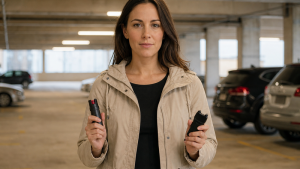
My strong recommendation: carry your alarm clipped to the outside of your bag, on a keychain you’re already holding, or in your hand when you’re in a transitional space — walking to your car, entering a parking garage, moving through an area that doesn’t feel right. Transitional spaces are where most attacks happen. Not inside the store, not inside your home — in the in-between moments. That’s when your alarm needs to be in your hand, not your bag.
A lot of alarms clip to a keychain with a standard ring, which makes them genuinely convenient. You’re already holding your keys when you walk to your car. Your alarm can be right there with them. That’s not just convenience — that’s smart positioning. And if you want protection closer to home, a wireless door alarm adds another layer of security that works while you sleep.
Can a personal alarm really scare off an attacker, or is it just noise?
I want to be honest with you here, because that’s the only way I know how to be. A personal alarm is not a guarantee. Nothing is. But here’s what it does that matters: it eliminates the element of surprise that most attackers depend on. Most people who prey on others are looking for easy targets. They want quiet, quick, no witnesses. A 130dB shriek does the exact opposite of what they need. It draws attention. It makes the situation visible. It turns a private crime into a public event.
Multiple studies on predatory behavior confirm what common sense already tells us — most attackers will disengage when they lose the advantage of surprise and isolation. The alarm doesn’t have to hurt anyone. It just has to make continuing the attack more dangerous for the attacker than walking away. That’s a lower bar than people think, and a loud alarm clears it consistently.
That said — and I can’t say this enough — an alarm works best as part of a layered approach to your safety. It pairs beautifully with awareness, with knowing your environment, and with having a backup option like pepper spray if the situation escalates. Read more about how a personal safety alarm actually works if you want to understand the mechanics behind why they’re so effective.
Are there personal alarms designed for specific situations or users?
Yes, and this is where it gets interesting. The personal alarm market has grown a lot in the last decade, and there are designs built for people with different needs, different carry styles, and different threat environments.
For college students and young women, compact keychain alarms in the 130dB range are ideal — small enough to disappear on a bag, loud enough to clear a campus quad. For elderly users or anyone with limited grip strength, pull-pin models are often the best choice because activation doesn’t require finger strength or fine motor precision. For someone who travels frequently, there are combination alarms that work as both a personal alarm and a door security alarm — genuinely useful for hotel rooms. And if you travel by air and are wondering about what’s allowed in your carry-on, you’ll want to check out the TSA rules for personal alarms on planes before you pack.
There are also multi-function alarms — some include a built-in flashlight, some pair with a wrist strap, some are designed to be worn as jewelry. The Streetwise and Stun Master lines both include alarm-equipped models worth looking at. The right alarm is the one that fits your life well enough that you’ll actually have it with you.
Frequently Asked Questions About Personal Alarm Decibel Levels and Effectiveness
What is the minimum decibel level a personal alarm should be to be effective?
A personal alarm should be at least 120dB to be considered effective for real-world self-defense situations. At 120dB, the sound is comparable to a chainsaw or a rock concert at close range — loud enough to disorient an attacker and draw attention from nearby people. If you can find a 130dB model, that’s the stronger choice and worth the small upgrade.
How far away can a 130dB personal alarm be heard?
A 130dB personal alarm can typically be heard up to 600 feet away in open outdoor conditions — roughly the length of two football fields. In enclosed spaces like parking garages, stairwells, or hallways, sound bounces and carries even farther. In loud urban environments, effective range is shorter, which is exactly why maximum decibel output matters so much in real-world scenarios.
Can a personal alarm actually stop an attacker, or just slow them down?
A personal alarm works primarily by eliminating the attacker’s advantage of surprise and isolation. Most predatory attackers disengage when the situation becomes loud and visible — the alarm signals that witnesses may respond. It won’t stop every attacker in every situation, which is why pairing it with awareness and ideally a second layer of protection like pepper spray is always smart.
Are personal alarms legal to carry everywhere?
Personal alarms are legal to carry in all 50 states and are among the least regulated personal safety tools available. They’re also generally TSA-approved for carry-on luggage, though policies can vary and it’s worth checking before you fly. Unlike pepper spray or stun guns, personal alarms have essentially no legal restrictions in the United States.
How long does a personal alarm sound last before the battery dies?
Most quality personal alarms are designed to sound continuously for 30 minutes or longer on a fresh battery. That’s far longer than any attack scenario would last — and long enough to continue drawing attention even if you’ve had to drop the alarm or move away from it. Check your specific model’s battery life specs and replace or recharge batteries regularly.
Should I test my personal alarm regularly?
Yes — test it monthly. A brief one-to-two second activation confirms the battery is charged and the mechanism is working. Don’t wait until an emergency to find out the battery is dead. Think of it like a smoke detector: you wouldn’t skip testing that. Develop a habit of checking your alarm on the first of every month. It takes five seconds and it matters.
Is a personal alarm enough protection on its own?
An alarm is a strong starting point but works best as one layer in a broader approach to personal safety. Awareness of your surroundings is always layer one. A personal alarm adds a powerful deterrent. Depending on your comfort level and local laws, adding a second tool — pepper spray, a stun gun, or a self-defense keychain — gives you more options if the situation escalates beyond what noise alone can resolve.
What features should I look for beyond decibel level when buying a personal alarm?
Beyond hitting at least 120–130dB, look for: one-handed activation you can perform under stress, a clip or keychain attachment that puts it on your body not buried in a bag, a durable weatherproof build, and a battery that’s easy to replace or recharge. A built-in flashlight is a genuine bonus — most dangerous situations happen in low light, and having both in one tool is smart design.
Here’s what I want you to take away from all of this: the decibel rating on a personal alarm isn’t just a spec number. It’s a measure of how much protection that little device can actually give you in the moments that count. When you’re standing in a dimly lit parking garage and something feels wrong, you want the loudest, most reliable alarm you can get your hands on — and you want it right there in your grip, not at the bottom of your bag.
I built Brainstorm Security Shop because I believe everyone deserves to feel safe, whether they carry a firearm or not. A personal alarm at the right decibel level is one of the simplest, most accessible tools we carry — and it just might be the most important thing you put in your pocket today. You don’t have to carry a gun. But carry something. Stay safe out there, and may you and your loved ones stay protected.