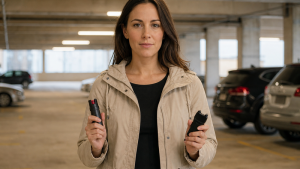
Not every personal alarm sold online is actually loud enough to matter. The number to look for is 120 decibels or higher — anything less can get swallowed up by car engines, wind, and distance in a real parking lot. The best parking lot alarms combine a piercing 120–140dB siren with an easy one-hand activation method, because the alarm that takes you five seconds to figure out is the one that doesn’t get used at all.
What decibel level does a personal alarm actually need to be heard in a parking lot?
Here’s what most product listings won’t tell you outright: decibels aren’t just a number on a spec sheet — they’re the difference between an alarm that turns heads across three rows of cars and one that gets lost the second a truck engine turns over nearby. You need 120dB minimum. Below that, you’re gambling.
Parking lots are noisy, echo-heavy, and full of competing sound — idling engines, car alarms, distant traffic. A alarm rated at 100dB might sound impressive in a quiet living room demo video, but drop it into that environment and it disappears. The alarms worth carrying sit in the 120–140dB range, loud enough to be heard through a closed car window from a good distance away.
There’s a reason most people never check this number before buying. It’s not printed in bold on the packaging. It’s buried in the fine print, if it’s listed at all. That’s the first thing separating a real safety tool from a novelty keychain — and it’s worth asking about before you buy.
How does a personal alarm actually help in a parking lot confrontation?
A loud personal alarm works on a principle most people never think about: predators rely on privacy. The moment sound draws attention, the entire equation changes. It’s not about the alarm physically stopping anyone — it’s about what happens in the three seconds after it goes off, when a quiet situation suddenly isn’t quiet anymore.
What’s less talked about is the psychological effect on the person carrying it. An alarm gives you something to do with your hands and your fear in a tense moment — a single motion that shifts you from frozen to acting. That shift matters more than people give it credit for.
Some models pair the siren with a flashlight function, which adds another layer most shoppers don’t think to ask about — sound to draw attention, light to disorient or illuminate. We go deeper into how that combination actually functions in real use in this breakdown of personal alarms with flashlight and siren features.
What’s the difference between a keychain alarm and a wearable alarm?
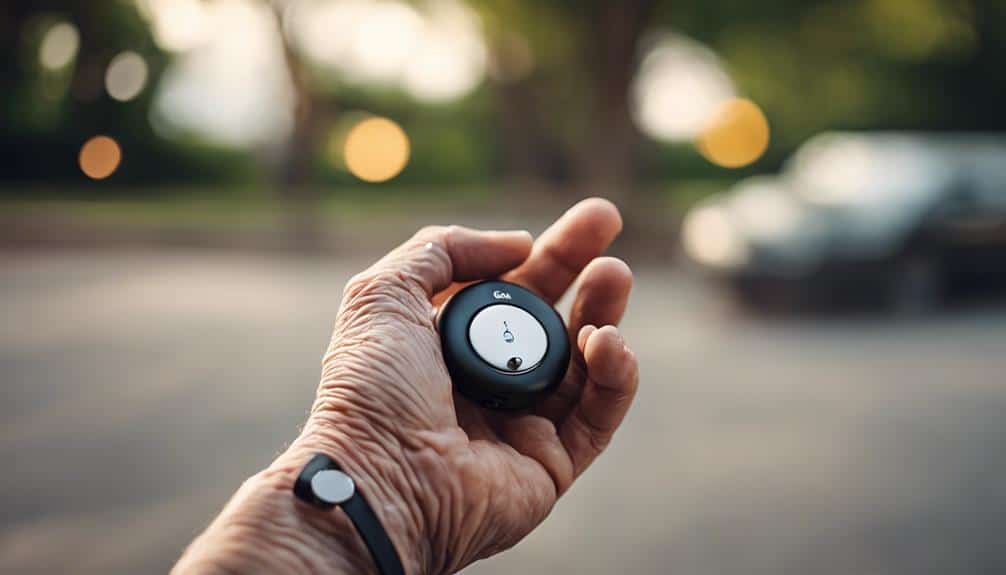
The difference isn’t just size — it’s what happens in the moment your hands aren’t free. A keychain alarm depends on you reaching for your keys. A wearable alarm, clipped to a bag strap or worn around the wrist, is already on your body when the moment arrives. That’s not a small distinction. It’s the entire distinction.
Most people buy based on how discreet or compact something looks on a store shelf. Almost nobody buys based on how fast they could activate it one-handed, in the dark, with their heart rate already spiked. That’s the wrong way to shop, and it’s exactly why so many alarms end up buried at the bottom of a purse instead of clipped somewhere reachable.
If you’re walking to your car after a late shift or crossing an empty lot after class, the alarm that matters is the one on your keys or your belt loop — not the one in a bag you’d have to dig through. Something like a personal alarm built for runners is designed around exactly this problem — worn, not carried, so it’s there the instant it’s needed.
Who actually needs a personal alarm — and who’s overlooking one?
The obvious answer is anyone walking alone at night. The less obvious answer is almost everyone else too — and that’s where most people get it wrong. Personal alarms aren’t a niche product for one type of person walking through one type of risk. They quietly solve problems in situations you wouldn’t expect.
Travelers navigating unfamiliar cities and unfamiliar parking structures benefit in ways that go beyond personal safety — an alarm can also draw attention to a hotel room door or luggage in a way most people never consider. We cover that angle specifically on our page for personal alarms for travelers.
Elderly individuals living alone face a completely different but equally real set of scenarios — a fall in a parking lot, a moment of disorientation, a need to draw help fast without dialing a phone. That’s a use case most people never connect to “personal alarm” until they’re the one who needs it, and it’s worth reading about on our personal alarms for elderly page.
And there’s a use case almost nobody thinks about at all: sleepwalkers and household members who need to know when a door or window has opened in the night. That’s a different product entirely — door and window alarms for sleepwalkers — but it shares the same underlying logic. Sound is information. Sound is a warning system nobody can ignore.
What features separate a real safety alarm from a gimmick?
There’s a quiet test worth running before you buy anything: could you activate this in under two seconds, in the dark, without looking at it? If the answer is no, keep looking. That single question filters out most of the gimmicks on the market faster than any spec sheet.
Beyond decibel rating and activation speed, look for pin-pull or button-press mechanisms that don’t require fine motor control — because adrenaline wrecks fine motor control. Battery life matters too, since an alarm that’s dead in your bag is worse than no alarm at all, because it gives you false confidence.
Some models fold in a flashlight, which sounds like a minor add-on until you’re standing in an unlit lot at 11pm and suddenly it isn’t. Others integrate directly into keychains so the alarm is never a separate item you have to remember to grab. The right alarm disappears into your routine until the one moment it doesn’t.
Where does a personal alarm fit next to other self-defense tools?
This is the part most buyers skip past — a personal alarm isn’t meant to be your only layer. It’s one piece of a bigger picture, and understanding where it fits changes how you think about carrying one at all.
An alarm draws attention and buys time. It doesn’t physically stop anyone the way a stun gun or pepper spray might. That’s not a weakness — it’s a design choice, and it’s exactly why it works well stacked alongside other tools rather than instead of them. We break down exactly how alarms compare to stun guns and pepper spray in real scenarios in Stopping Power Compared, and the same layered thinking applies at home — covered in Layered Home Security and in our look at whether door alarms actually deter burglars.
Renters and apartment dwellers face their own version of this same layered question, especially with entry points they don’t fully control — something we get into on our door and window alarms for renters and apartments page.
Frequently Asked Questions About Personal Alarms for Parking Lots
How loud does a personal alarm need to be to work in a parking lot?
Look for 120 decibels minimum, with many effective models reaching 130–140dB. Anything quieter risks getting lost in the ambient noise of engines, traffic, and echo that’s common in parking structures and open lots, especially at a distance.
Can a personal alarm actually stop an attack?
A personal alarm isn’t designed to physically stop anyone — it’s designed to draw immediate attention and disrupt the moment, which is often enough to change the outcome. It works best paired with awareness and, for many people, an additional tool like pepper spray or a stun gun.
Where should I clip my personal alarm so I can actually use it?
Anywhere you can reach without looking — a keychain, a bag strap near the top, a belt loop, or worn on the wrist. The alarm buried in the bottom of a purse or backpack is the one that never gets used when it counts.
Do personal alarms need batteries, and how often should I check them?
Most run on replaceable batteries, and it’s worth testing the siren every few months to confirm it still fires at full volume. A dead alarm gives false confidence, which is arguably worse than carrying nothing at all.
Are personal alarms legal to carry everywhere?
Personal alarms are legal in the vast majority of places since they don’t project anything and cause no harm — they simply make noise. That said, always check your specific location’s regulations, especially in restricted environments like schools or certain federal buildings.
What’s the difference between a personal alarm and a car alarm sound?
A personal alarm is pitched and designed specifically to sound distinct from ambient car alarms, engine noise, and traffic — it’s built to cut through and be immediately recognized as a distress signal, not blend into background city noise.
Do personal alarms work well for college students walking to their cars at night?
Yes — they’re one of the most commonly recommended tools for that exact scenario, especially paired with awareness habits like walking with keys ready. We cover how they compare to other legal campus options in our guide to self-defense weapons for college students.
Should I get an alarm with a flashlight built in?
It depends on how you’ll use it, but the combination solves two problems most people carry two separate items for — the ability to draw attention with sound and see or disorient with light, all from one activation.
Most people walk past the personal alarm display and never ask the one question that actually matters — how loud, how fast, how ready. That question is the whole difference between a tool that works when your hands are shaking and one that just sits quietly in a bag, unused, until it’s too late to matter. Ask it before you buy, not after.